

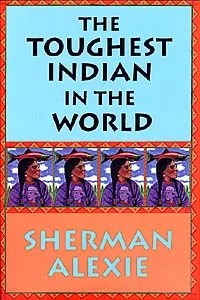
The Toughest Indian in the World
by Sherman AlexieAtlantic Monthly Press, 238 pp., $24
Sherman Alexie’s new collection of stories is about bridges and borders — literal ones, cultural ones, racial, class, and sexual ones — and the clumsy, funny, desperate ways we find to cross them, or don’t.
You may know Alexie’s award-winning screenplay for the film Smoke Signals, which was based on his popular short story collection The Lone Ranger and Tonto Fistfight in Heaven. This new collection’s strengths, which are many, include peculiar, deadpan wit and sharp lyricism, as well as a fresh, often challenging perspective on American culture. The weaknesses, which are few, include occasional straining for effect.
Sex, specifically surprising or transgressive sex — adulterous or homosexual, sex that crosses borders — appears throughout these stories as a way for Indians to strengthen each other and for Indians and whites to connect. For example, in the neatly made opening story, “Assimilation,” an Indian woman married to a white man begins to long for sex with an Indian, any Indian: “White men were neutral, she thought, just like Belgium! And when has Belgium ever been sexy? When has Belgium caused a grown woman to shake with fear and guilt?” And she does, finally, choose almost at random a fat, scarred, rather perplexed Lummi Indian with whom to betray her husband and relocate her self. But the story ends in a moment of exquisite epiphany, with the woman and her husband trying to reach each other across a bridge that is jammed with traffic caused by a woman’s suicide. Its final sentence: “She and he loved each other across the distance.”
In the title story, the middle-class Indian narrator, a bored newspaper feature writer, picks up a lower-class Indian hitchhiker, a man who travels from reservation to reservation fighting for money. Quite unexpectedly, they end up having sex, the narrator’s first homosexual experience. “I knew that I would be sore for days afterward. But I wanted him to save me.”
The longest, most daring, but least successful of these stories is “The Sin Eaters.” It opens with a chillingly poetic evocation of medical horror, but soon Alexie’s tightly wound mood of apprehension unravels. The story devolves into unprocessed fantasy with science fiction overtones, as whites kidnap, imprison, and torture Indians for the medical uses of their blood. Rife with incautious Holocaust images, the story doesn’t work. It’s not clear why a writer as skillful and subtle as Alexie feels the need to invent a simplistic fantasy of genocide and racism, when the reality of Indian history is so horrific.
“One Good Man” is the elegiac final tale, an exquisite rendering of the love between a dying father and his adult son. “What is an Indian?” is this story’s repeating refrain, but the answer keeps changing. Makeshift, half-joined cultures are made to work: Divorced, the son spends holidays with his ex-wife, their son, and her new (white) husband. “Thank you for being kind to me,” the husband says. “I know it could be otherwise.”
Later, the narrator takes his father to visit Mexico. “South of Tecate, California, the van broke down. Then, five minutes later, north of Tecate, Mexico, my father’s wheelchair broke down. … We laughed. We waited for hours for somebody to help us.” The final image is a vivid capsule of Alexie’s modern Indians: “What is an Indian? I lifted my father and carried him across every border.”
This article appears in August 18 • 2000.