

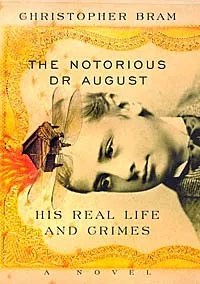
The Notorious Dr. August: His Real Life and Crimes: A Novel
by Christopher BramMorrow, 498 pp., $26
“Lies are the oil that keep the machine of the world running smoothly,” Augustus Fitzwilliam Boyd muses near the end of The Notorious Dr. August, Christopher Bram’s poignant historical epic that melds a life’s worth of deceit, trickery, and fraud into a design for internal prosperity. Boyd, known as Dr. August to many, is a feeble, blind old man recounting his “life and crimes” to a dear friend, an account rendered with amusing anecdotes and sarcastic charm. Starting with the Civil War and ending sometime in the Roaring Twenties, August fills his tale with all the bloody details one might expect from such a “notorious” existence — betrayals, scandals, affairs, and the like — without losing sight of the tempestuous societal changes that marked the various eras (Reconstruction, Victorian, Progressive) of the period. The result is a hugely entertaining, historically rich, theologically complex exploration of life (and the afterlife) that uses an eclectic cast of characters to depict (and criticize) a world climate changing with every year’s passage.
Bram’s tale hinges on the love triangle between August, a world-renowned pianist in contact with spirits, Isaac, a former slave with whom August falls in love after they escape captivity from a group of rebels, and Alice, a pristine governess who falls for Isaac against the admonitions of her genteel society. Complicating matters in this rather unconventional triangle is Isaac’s love for August, which oscillates between brotherly and sexual until Alice enters the picture. Isaac, August, and Alice carry this tension through years of traveling around Europe, where August gains fame and riches from his piano concertos with the spirits and Alice and Isaac begin a family.
“We were like a dog and a cat who find themselves stranded on a desert island,” August says of his vulnerable relationship with Alice, one that takes precedence in the novel when Isaac leaves the two of them stranded in Europe in order to find his place with God in America. Culminating in a return to America that finds Alice and August virtually inseparable, the book shows the importance of human relations regardless of ideology.
What distinguishes The Notorious Dr. August from other historical fiction is Bram’s finesse in structuring a story that isn’t sanctimonious or condescending. He allows his characters to adapt to or reform the shifting norms of society, whether they concern race, sexuality, or class, and with varying results. Though Bram filters his novel through August with a pointed, liberal slant, his other characters are given generous priority in expressing their ideas. August, Alice, and Isaac together make an ideological spectrum.
As a historian, Bram infuses his story with subtle detail and unabashed imagination. He’s clearly done his research, yet he doesn’t let the specifics of the setting overtake the characters. They function as tour guides, bringing to life the despair and treachery of post-Civil War race relations, or the splendor of discovery in the magical escapism of Coney Island in the Twenties. And, as seen through the mind of August, there’s always room for humor in the most desperate situations.
This article appears in August 18 • 2000.