

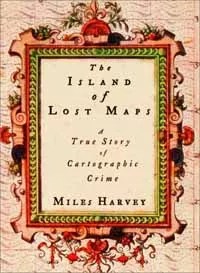
The Island of Lost Maps: A True Story of Cartographic Crime
by Miles HarveyRandom House, 405 pp., $24.95
In December 1995, Gilbert Bland Jr. was apprehended in Baltimore after stealing several maps from Johns Hopkins University’s George Peabody Library. This news item, in itself, seems unremarkable given the depth and breadth of crimes that occur on a daily basis. But for writer Miles Harvey, Bland’s case opens a door to a world far more complex and entertaining than you might anticipate.
In The Island of Lost Maps, Harvey reveals a community of collectors, traders, librarians, and thieves whose taste for cartography — the study of maps — is voracious enough to Harvey to peg it as cartomania. While Harvey defines himself as a documentarian and outsider, he has enough enthusiasm for the subject, and appreciation for the people he chronicles, that Island functions as an erudite and literary Hands on a Hard Body.
Why do certain people steal maps? That’s the initial question Harvey implicitly forwards, and the historical reasons provide an initially compelling answer. He goes to the 16th century, when Dutch thieves stole Portuguese maps, thereby uncovering secrets, shifting naval power, and altering the course of history. He goes back further, revealing how map theft may have enabled Columbus to get permission from Spanish royalty to sail, and positing theories that explorers like Marco Polo may have explored — and pilfered details from — others’ maps rather than others’ actual lands. He goes back and forth between the past and the present to show that an attraction to maps is actually a reflection of the most basic human wants, needs, and flaws. And he goes at great lengths to show that Bland, while extremely active in his clandestine endeavors, is hardly alone.
Harvey, in the process of investigating Bland, uncovers a number of larger-than-life characters, and finds himself in settings ranging from a North Carolina town so tiny residents don’t even recognize it as a town, to a New York City auction where a book of maps sells for over a million dollars. The book, an outgrowth of a magazine article Harvey wrote in 1997, is a complicated weave of history, philosophy, and even poetry. Harvey is clearly enjoying himself here, and occasionally will lapse into cloying language and puppy-playful punning in an attempt to bridge ideas and drive home the point that Bland’s bland exterior allowed him to evade authorities for years. These lapses, ultimately, are more potholes than detours, the minor side-effect of sustaining a narrative about a map thief over the course of 350 pages.
Those who do not possess at least the slightest bit of interest in maps should proceed with caution, if at all. The book is a true-life, nonfiction crime story — albeit, more a whydunnit than whodunnit. Yet it is, ultimately, a sort of love letter to those involved with the world of mapping the world, and only the most unappreciative reader will come away without a better understanding of what pulls certain individuals toward two-dimensional representations of a three-dimensional world. Even Bland, cast as the villain of the book by the nature of his crime, is more of a Kurtz-like figure Harvey goes to great lengths to seek than an easily disposable anti-hero. Along the way, the reader will encounter enigmatic collectors, the Donald Trump of the map-trading world, and librarians and book restorers who emerge more Dirty Harry than you’d ever imagine. It’s reasonable to conclude that Harvey intended the book as a map. As maps go, this one is engagingly artistic and detailed, as fanciful and decorated as some of the collectible antiquities mentioned between the covers.
This article appears in October 6 • 2000.