

“Lester’s Last Stand: Behind
the Tall Tales of Lester Bangs in Texas” is an excerpt from a longer chapter in
Let It Blurt: The Life and Times of Lester Bangs. Author Jim DeRogatis
describes the book as “an ongoing project and a labor of love.” He would like
to thank the 30 or so Austinites he interviewed for this piece, including those
who were quoted here and the many who were not.
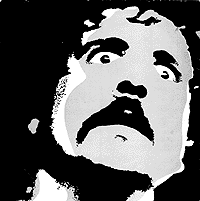 Lester Bangs from the cover of the Spy 7″ “Let It Blurt” |
Delinquents before they ever set foot onstage at the venerated Armadillo World
Headquarters. The only question was how much blood would be shed.
Disillusioned by the small-mindedness of the C.B.G.B.’s scene and burned out
by New York in general, Lester came to Austin in the fall of 1980 for a lost
weekend that lasted four months. He was the great gonzo journalist, gutter
poet, and romantic visionary of rock writing — its Hunter S. Thompson, Charles
Bukowski, and Jack Kerouac all rolled into one. Over the last decade, he had
reveled in rock’s excesses and matched its passion in his prose, celebrating
honesty, emotion, and energy over bullshit like technical prowess. His “anybody
can do it” ideal had been adopted by the punk and new wave movements, but
Lester still felt he had something to prove, and he intended to do it at the
Armadillo.
In 1977, Lester released a single called “Let It Blurt” on John Cale’s Spy
Records. Over a jagged, tense groove created by guitarist Robert Quine and
Patti Smith drummer Jay Dee Daugherty, he railed at a woman who lied to him
about being pregnant with his child. “Sitting on the dock of the bay /
Drinking port wine and listening to `Sister Ray’ / Wondering why I wasn’t born
gay / Sometimes I feel just like an offay,” he sang. It was a tortured and
cathartic recording, but it was perceived as a novelty: a critic dabbling in
the medium he critiqued.
Lester insisted that his desire to make music and his desire to write about it
were both part of the same obsession. He went on to form a regular band,
Birdland, with guitarist Mickey Leigh,aka Joey Ramone’s brother. But
after three years of rehearsing and steady gigging, the star and singer was
given the boot because he was too fat, he couldn’t sing, and his bandmates were
no-good sell-outs (Lester’s version), or because his drugging, drinking, and
tyrannical ways made it impossible to work with him (his bandmates’ version).
Since his early teens in the San Diego suburb of El Cajon, records had held a
magical power over Lester. He hid them behind his bed lest they be discovered
by his mother, a strict Jehovah’s Witness, and he often said his ultimate
fantasy was to own a mansion built over vast catacombs filled with every
recording ever released. Lester longed to immortalize the songs he’d been
writing on an album. Lured by accounts of the vibrant music scene, he came to
Austin to realize that dream.
Nov. 21, 1980, was to be Lester’s moment of triumph onstage before entering
the recording studio. The Talking Heads were playing the Armadillo, the concert
hall made famous by the giants of outlaw country. The Armadillo was about to
close for good on New Year’s Eve, and every punk and new wave band in town
wanted a last chance to play there in front of a sold-out crowd. In a rather
crass display of his clout, Lester landed the gig with one phone call to the
Heads’ manager, Gary Kurfirst. His initial plan had been to put together a band
of Austin all-stars, but after rehearsing with members of the Huns, the Next,
and others, he changed his mind and hooked up with an existing group, garage
punks the Delinquents.
Unfortunately, Nov. 21 was also the night the producers of Dallas
answered the question, “Who Shot J.R.?” Many people skipped the opening set
and stayed in front of their TV sets. A large number of those who did
show up on time seemed to be nurturing grudges: The Delinquents had never
been the most popular group, and now they were openly hated for landing the
coveted Heads gig. As usual, Lester bounded onstage to the tune of “You Can’t
Sing,” a James Brown-style groove that featured him bellowing tunelessly on
top. People covered their ears, and then they noticed what he was wearing.
At the height of the punk era, there was no deeper divide than the one between
the punks and the frat boys. Lester was wearing a pink Izod polo shirt, the
very symbol of privileged frat culture. The booing started quietly at first,
but it quickly grew louder, and it filled the Armadillo for much of the set.
What Lester had intended as a supreme celebration of his punk ethos turned
against him in part because he didn’t look punk enough.
Lester had been hearing about Austin for years from friends and fellow Creem alumni Joe Nick
Patoski and Ed Ward. Patoski was managing Joe “King” Carrasco & the Crowns,
and Lester fell in love with the band when it traveled to New York in late
1979. It was at a party for Carrasco thrown by Karen Moline, the editor of
Lester’s Blondie biography, that Peter Buck and Michael Stipe met their
rock-critic hero, a scene that was later recounted in R.E.M.’s “It’s the End of
the World as We Know It (And I Feel Fine).”
“I loved Lester because he cut through all the bullshit,” Carrasco says. “I
remember one time he was talking to me and he said, `I’m a rock `n’ roll
innocent.’ I think he was referring to his love life. That was probably the
predominant thing in both of our lives: Women couldn’t make sense out of us. He
was totally burned out on romance and music and pretty much everything else.”
Carrasco and the Crowns had released a single on GeeBee Records, an indie
label started by Austin scenester Gretchen Barber. The label was bankrolled by
Barber’s boyfriend at the time, ZZ Top guitarist Billy Gibbons. “Billy had his
agenda, and his agenda was that Deguello was almost out,” Ward recalls.
“I don’t want to put him down for it, but he basically hitched a credibility
ride and got into the new wave scene and the credible critics with that album
and with Joe `King’ Carrasco.”
Lester met Gibbons through the Carrasco crowd. Both men were knowledgeable
music fans and dedicated storytellers, and they became friends. Admitting that
he had never liked ZZ Top in the past, Lester wrote a flattering profile of the
band for Musician, Player & Listener and a rave review of
Deguello for Rolling Stone. Gibbons showed his appreciation by
inviting Lester to fly to Houston in September, 1980.
Lester had been sold on the idea that some time in the Texas sun was all he
needed to cure his ills. Despite his stature, he was still living hand to
mouth. It’s possible that he thought he could accept Gibbons’ offer because
he’d long since proven his independence by biting the hands that fed him. It’s
just as possible that he never thought twice about the journalistic ethics.
Either way, Lester hoped Gibbons’ largesse would extend to financing his album,
but the guitarist made it clear that he wasn’t up for that. Undaunted, Lester
accepted the invite and figured he’d find some way to record once he got to
Texas.
“We picked up Lester from the airport: Billy, his stockbroker, and me in a
Cadillac convertible,” Barber says. “Lester got off the plane and he had no
clothes with him — just the jeans and T-shirt he was wearing — and he was
carrying an old-fashioned, funky tape recorder and a stack of notebooks and
stuff that he kept dropping. He kept saying, `Man, I haven’t been out of New
York City in years. You don’t know what this means to me.'”
Since Lester arrived sans luggage, Gibbons told Barber to take him to Neiman
Marcus and buy him some clothes. She did, picking out everything from cowboy
boots and khaki pants to the unfortunate choice of a pink Izod polo shirt.
Gibbons put Lester up in style in a downtown hotel, but while Lester enjoyed
shooting the shit with his hirsute host, he found Houston unbearably boring.
They took a few day trips — Gibbons treated Lester to a disastrous weekend of
deep-sea fishing and dove hunting in south Texas — but Lester was anxious to
get to Austin, so he and Barber set off for her house in the capital city. An
unapologetic slob of long standing, Lester had the ability to turn any room
into a disaster area in no time flat. Not surprisingly, he was soon relocated
again to Austin’s Alamo Hotel.
Perched on the corner of Sixth & Guadalupe, the Alamo was a grand and
stately old place that had fallen on hard times: It was now known primarily as
the hotel where Sam Houston Johnson drank himself to death. In the early
Eighties, the lounge was also home to a new wave of singer-songwriters —
people like Nancy Griffith, Joe Ely, and Butch Hancock — and while they
weren’t exactly Lester’s bottle of Romilar, he was closer to being in his
element than he had been in Houston.
Austin was just starting to be recognized as one of the country’s strongest
regional music scenes. There seemed to be music everywhere, and Lester counted
almost 40 live-music clubs. The nexus of the punk and new wave scenes was
Raul’s on Guadalupe near the University of Texas. Giant rats were painted along
one of the interior walls, and graffiti about local bands covered the outside.
Duke’s Royal Coach Inn on Congress between Third and Fourth was also booking
punk bands. A mariachi bar by day, it had formerly been the Vulcan Gas Company,
the psychedelic rock club haunted by the 13th Floor Elevators. Like many
people, Lester thought the Velvet Underground had recorded 1969 Live there — they hadn’t — but for that reason alone, Lester loved it.
Carrasco and the Crowns were in Europe recording their first album for Stiff
when Lester arrived, and they didn’t return until after he left. Given his
reputation, it wasn’t hard for Lester to find other enthusiastic tour guides.
“I had worshipped Lester from afar as a rock critic,” recalls Margaret Moser,
who was still an aspiring writer in that pre-Chronicle time. “Within
about four hours of meeting one of the rock critics that I had worshipped and
admired, I was all of a sudden sitting in a bathroom shooting him up with
speed, looking into his sweaty face, and thinking, `This is a moment I’ll
remember forever.’ You know, it’s kind of a dubious thing, but that was the way
it was back then.”
Rockers and writers are both prone to a certain amount of hyperbole in the
interest of making a good story better, and the tendency to tell tall tales is
even more pronounced in Texas. Lester’s Austin adventures have a
larger-than-life quality in part because they’ve been repeated so many times;
they were even the subject of a panel at South By Southwest in 1992. Sometimes,
the stories don’t have much in common with the truth.
Word circulated that Lester was kicked out of the Alamo for hurling beer
bottles out his window and blasting Raw Power and Metal Machine
Music on his portable record player. This was a perverse badge of honor; as
Moser says, “It was really something when you were too low-down for the
low-down Alamo.” But Lester later wrote that he checked out because he was
“bored and lonesome.” Stewart Wise and Ellen Gibbs, two of the movers behind an
ambitious art and music fanzine called Contempo Culture, invited Lester
to stay at their house near the university, and he eagerly accepted.
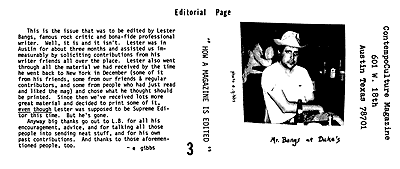 Ellen Gibbs’ editorial in the Contempo Culture issue Bangs edited. |
town, and I had been a fan forever,” Wise says. “I mentioned to [Gant] that I
would love to meet him, and she had no idea who he was. Well, about two days
later, she met him at Raul’s and brought him home. I was astonished because
Lester Bangs was in my living room. I was also kind of heartbroken, because he
looked like he was really sick. Here was this kind of dumpy guy who hadn’t
bathed in who knows how long. He smelled horrible and he was sweating like
crazy even though the a.c. was on. We went out and bought a bunch of beer and
wound up talking into the night. The next day, we packed up his stuff and moved
him into the house.”
Legend has it that Lester terrorized the Contempo Culture house, and
the four roommates eventually had to burn the couch he slept on. But while
Lester was banned from using the phone because he racked up hundreds of
dollars in unpaid long-distance charges, he made up for it by enthusiastically
promoting the zine. He contributed drawings, a story about noise-rockers DNA,
and an hysterical rant about right-wing rigidity to Issue No. 4, and he
guest-edited Issue No. 5, pressing friends like Joey Ramone to contribute.
Seven or eight weeks into his stay, he was asked to leave because the house was
too small and his mess was too big, but his hosts didn’t burn the couch. “We
just fumigated it,” Wise says.
Tales of Lester’s arrest are also exaggerated. They range from him starting a
brawl with Austin’s finest to urinating defiantly outside Raul’s. In fact,
Lester simply had too much to drink and fell down in the street while walking
to the club with Contempo contributors Gail and Cheryl Gant. “He was
suddenly on the ground and Cheryl and I were trying to pull this big guy up
when the police officer came over and said, `You girls having a problem?'” Gail
says. “We said, `Not really, officer. We’re just trying to help our friend
here.’ Well, they helped him alright, right over to jail.”
Lester was supposed to meet Ward and photo archivist Michael Ochs. Lester and
Ochs were working on a book called Rock Gomorrah that was to be rock’s
answer to Hollywood Babylon, a tell-all about the industry’s seamy
underside. Ochs had traveled from Los Angeles to visit with Lester, but he
learned that his friend had been busted when he and Ward got to Raul’s and ran
into the Gant sisters. According to Ward, Ochs was angry that Lester screwed up
his visit, and he refused to bail Lester out. According to Ochs, Ward was fed
up with Lester after weeks of petty annoyances, and he said a night in jail
would serve Lester right. When Lester was finally released the next morning, he
was furious, and he proceeded to tell everyone within shouting distance that
Texas was “a fascist police state.”
From the moment Lester set foot in Austin, he was looking for musicians to back him up. He invited
almost everyone he met to jam, whether or not they had any discernible talent:
Moser remembers banging two books together during one rehearsal. Jeff
Whittington, a rock critic for UT’s The Daily Texan, was the only person
in all of the “all-star” groups. Whittington idolized Lester and was thrilled
to be playing bass with him. “But what happened is that Brian Curley came to
rehearsal, and within 48 hours, the Delinquents were the band,” he
says.
Before linking up with Lester, the Delinquents’ claim to fame was that their
first 45, a surf instrumental called “Alien Beach Party,” had been selected as
Single of the Week by England’s New Musical Express. Curley was the
band’s bassist and driving force. He and his keyboardist-wife Mindy lived in a
comfortable three-bedroom house in the southwest suburbs. The biggest insult
that punks could hurl at each other in those days was that someone was a
trust-fund brat, and Mindy was a member of the family behind the Church’s Fried
Chicken chain. Brian maintained that they worked hard for what they had, and he
in turn dismissed the sniping as “jealous bitching by spoiled college kids.”
As a kid growing up in New Mexico, Curley loved the Grateful Dead, and he
remembered a Rolling Stone review where Lester bragged of “not merely
disliking the Dead, but hating them and all that they stood for.” The
Delinquents were playing their usual set at Duke’s one night when “this old
wino-looking guy brought a table into the middle of the dance floor and
proceeded to sit there and slosh pitcher after pitcher of beer all over himself
and all over the table, really make a spectacle of himself,” Curley says. In
between sets, the wino introduced himself.
“He came up to me and said, `I’m Lester Bangs, do you know who I am?'” Curley
says. “I said, `Yeah, I know who you are!’ And I just lit into him about why
I knew who he was: `I think you’re a fucking asshole for those record
reviews, man!’ And he put his arm around me and said, `You and I are going to
be great friends.'”
Lester had reconsidered the ad hoc approach and decided he needed a “real”
band. The Delinquents were more or less professional by punk standards, but
they weren’t so professional that Lester was intimidated by them. Curley
patiently sat and listened to Lester sing his lyrics, and he matched chords to
the crude vocal melodies. All told, Lester and the Delinquents played 14 shows,
including road trips to Dallas, Fort Worth, and San Antonio, and Austin gigs at
Duke’s, Club Foot, and a UT frat house.
Lester’s fondness for over-the-counter drugs was infamous, and he usually
prepped for a show by downing an unholy mixture of beer or wine, Ornical
decongestant tablets, and the ephedrine-coated wicks from Vicks nasal inhalers,
which he cracked open with the heel of his boot. It was such a mixture that
inspired a stream-of-unconsciousness account of the frat gig in which Lester
chided himself for falling prey to “the whole Byronic romantic-agony rock-star
shtick,” while at the same time proclaiming a drunken 20-minute rendition of
“Louie, Louie” as “the greatest version of all time.”
More objective listeners were harsher in critiquing the band’s live shows, but
the album that Lester and the Delinquents produced adds a dimension to Lester’s
legacy that can’t be gleaned from Psychotic Reactions and Carburetor
Dung, the posthumous collection of his writing. If the gigs suffered from
Lester’s lack of self-control, the recording sessions at Earth and Sky Studios
benefited from his gonzo passion. In the studio, Lester’s lyrics could finally
be made audible, and he could bring his considerable critical faculties to bear
in helping to realize the sound as he imagined it. (Curley tried to convince
him to take a producer’s credit on the finished album, but Lester declined.
“Producers suck,” he said.)
Several of the 11 songs dated from Lester’s Birdland days, including the
garage-rockers “I’m in Love With My Walls,” “Accidents of God,” and “Kill Him
Again,” a frightening portrait of a gang of murderous bullies. More recent
songs such as “I Just Want to Be a Movie Star” and “Life Is Not Worth Living
(But Suicide’s a Waste of Time)” were a cool mix of twisted blues and cowpunk,
with typically brilliant lyrics. “You call yourself a nihilist / Because you’ve
read Celine / Put cigarettes out on your wrist / You still won’t be James
Dean,” Lester sang in the latter.
Jook Savages on the Brazos was funded by Curley and released on his own
Live Wire label in late 1981. Village Voice critic Robert Christgau
described it as “the Velvets meet the Voidoids in Austin” and gave it a
deserving “B+.” The album never reached a large audience, in part because
Curley only pressed 1,000 copies. But among the fans who bought it were Boston
college buddies Paul Kolderie and Sean Slade.
“It’s so unusual for a rock critic to put his money where his mouth is and get
up there and write songs that are up to the standards that he held other people
to,” Kolderie says. Now the sought-after producers of Uncle Tupelo, Wilco, and
others at their Fort Apache Studios, Kolderie and Slade recently bought the
rights to Jook Savages and plan to reissue it on CD before the end of
1997. “I’ve been listening to that record for 15 years now, and I love it,”
Kolderie says.
WhenLester left the Contempo Culture house, he moved in with Veronica Albright
(Veronica Edmondson-Sullivan at the time), a nurse who palled around with the
Delinquents. “Lester liked me because I wasn’t real impressionable and I didn’t
know who he was,” Albright says. “He kept asking me, `Don’t you know who I am?’
And I’d say, `No, why don’t you tell me?’ It seemed everybody was fed up with
him. He’d made some enemies in town, and that’s probably why he liked me: I was
a fresh face.”
An incurable romantic, Lester never just slept with a woman, he fell madly in
love with her. He had several crushes during his time in Austin, but none
blossomed into the soulmate relationship he was so anxious to find. “He would
just talk about stuff and I would listen,” Albright says. “He would talk about
his life: Women don’t love him enough; people don’t love him enough. He’d say,
`People suck the life out of me. They take everything…. I feel just like
Jesus Christ.'”
Lester’s idealized view of Austin had started to change even before his
arrest. When he was hanging out at the house near campus where the Delinquents
rehearsed, frat boys pelted him with eggs whenever he walked to the store to
buy beer. And he was dismayed to find the same disdain for black music at
Raul’s that he found at C.B.G.B.’s. “Austin seems largely unaware of the
possibility that black musical forms could have anything to do with New Wave
music,” he wrote. “`I been hearing that blues shit all my life,’ said Gary of
Raul’s when my band auditioned there. `I like modern music.'”
Then came the Armadillo show. “Lester and the Delinquents were horrible, and I
was embarrassed for him,” Albright says of Lester’s big gig.
“The Delinquents were never any good, and now they were the Delinquents with
Lester in front of them,” Ward says. “I remember that it was fairly
horrible.”
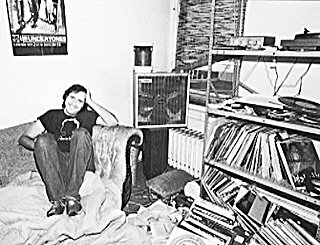 Lester bangs in his New York digs (from Psychotic Reactions and Carburetor Dung |
centerstage, and they were giving the thumbs-down. Armadillo audiences were
notoriously lenient; if anyone had the guts to get up there on stage, it was
felt that they at least deserved a polite response. I remember this being one
of the few exceptions to that.”
“The Armadillo show really did to the Delinquents what Lester didn’t want to
do: It made us the band everybody loved to hate,” Curley says. “Lester was much
more sober than he had been in the past, and he was very nervous, which I had
never seen before. He was like, `I can’t be fucking up now; I’ve got to try and
be good.’ I still think that somebody tried to sabotage us that night, because
in the middle of the first song, the monitors went off onstage, and we played
the whole fucking set without any monitors. Lester looked at me when it
happened, and I was like, `Just go for it.’ Some people were booing, but I
stood at the edge of the stage and flipped them off. It was all the people who
tried to be in his band at the start.”
The Armadillo gig was the last time Lester ever played music live. By
mid-December, Jook Savages was finished, and the Delinquents had
outlived their usefulness. Lester hadn’t met the love of his life in Austin;
he’d made a scene at most of the clubs, and he’d alienated many of his friends.
Plus, he was homesick. “I guess I’m just a sick dog, a connoisseur of
neuroses,” he wrote. “All I know is my hands shake half the time here and they
never do in N.Y.C. It’s gotta be all this damn placidity and niceness. Too much
of a good thing can make you bilious at best and kill you otherwise. I just
hafta go back and skulk with the sickies — my own kind.”
Lester returned to New York in time for New Year’s, 1981. In retrospect, his
Austin visit was a turning point: In the 16 months after he left Texas, he
sobered up, attended Alcoholics Anonymous, and tried to live a healthy
lifestyle. He even cleaned up his apartment. He was working hard to finish
Rock Gomorrah, and he was planning to go to Mexico to write a novel
called All My Friends Are Hermits. He was determined to make his
literary mark with something less ephemeral than record reviews, and he was
going to make the brave move into fiction with the same gusto he’d shown for
music writing and music making.
“There was a time in my life when you would have come up here and I would have
got all drunk and everything, and you might have preferred it that way,” Lester
told me on April 14, 1982, when I spent a long afternoon interviewing him for
my high school newspaper. “But if I act like that, I won’t live very long as a
good writer. Charles Bukowski has reached a point where he writes poems about
how he can’t write anymore. And Hunter Thompson pays more attention to his
image than his work. I went through something like that on a pissant level at
Creem, and it’s left me with a lingering paranoia. But I think that it’s
better that way, because you live longer and you last longer as a writer.”
Two weeks later, on April 30, 1982, Lester Bangs was found dead in his New York apartment. Feeling the
onset of the flu, he had taken some Darvon, a synthetic painkiller that he
purchased from the pill pushers on 14th Street, and he simply stopped breathing
in his sleep. He was 33 years old.
Jim DeRogatis is a freelance rock writer living in Minneapolis. He
contributes regularly to Los Angeles New Times, the Chicago
Reader, and Request magazine, among many other publications, and is
the author of 1996’s Kaleidoscope Eyes: Psychedelic Rock From the ’60s to
the ’90s. He continues to uphold the ideals put forward by Lester Bangs: an
unfailing honesty to the reader (don’t believe the hype), a sense of humor
befitting the topic (it’s only rock & roll), and a writing style that
captures the rhythm of the music (a bop a loo bop, a wop bam boom).
This article appears in March 7 • 1997 and March 7 • 1997 (Cover).