

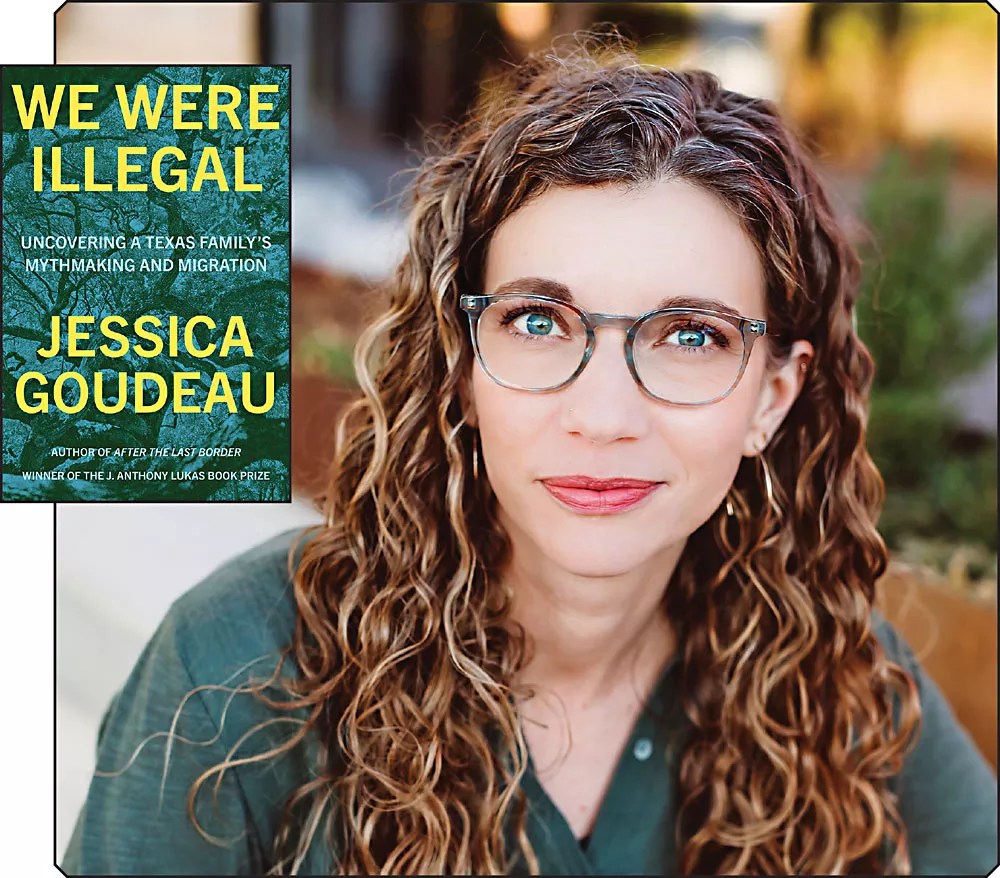
Jessica Goudeau’s previous book, 2020’s award-winning After the Last Border, chronicled the tales of two refugee families settling in Texas against the backdrop of growing extremist backlash against immigrants in America. For her second book, she tackles a more personal history of her own family to explore who gets to claim legality and how the stories of our history shape our current conversations.
We Were Illegal looks to complicate Texas history even from its title. Goudeau traces her family’s roots to the very first Anglo settlers of the territory, and even further back to some of the earliest families in Virginia. Yet even in exhuming those foundational histories, she reckons with a history of violence, ambition, and refuge that intertwines her family’s past with that of Texas.
“I kind of wanted to challenge the view of who are the immigrants, who are the newcomers,” she explains. “I think we always have this idea that we’re the legal residents who get to make these decisions, but don’t recognize that we often did the same things in the past. My relatives crossed the border illegally, without documents, or they broke the law and got away with that. So what do we do when we were the ones who were kind of fudging those lines, but then we got to pass history down because we were in power?”
Perhaps even more importantly, Goudeau provides a structure for how to conduct genealogical work within a restorative framework, one that can account for a more nuanced history of oppression and colonization that includes its often forgotten victims in a united story. She seeks to exhume the stories of those her family enslaved and displaced, but in a way that curates a shared history that allows for recognition and new foundational narrative to build upon together.
“This started out trying to understand my own family story, but it ended up pretty quickly looking at six different times of extremism in Texas, and also the larger United States,” she says. “I think we often have this feeling like we’ve never been here before, but I think that sense of ‘nothing is ever going to get better’ changes generationally. So I think this is part of almost like a growing-up process, of our country really reckoning with our true past. I always have hope, because at least in the United States, we can still talk about these things. We still have the freedom to speak out and tell different stories and challenge each other.
“I think part of what this has shown to me is that we are hungry for more nuanced conversations,” she continues. “We live in a society right now that is so binary, it’s so kind of outraged all the time, and yet I think we’re hungry to talk about things in a more complicated way, and to have critical thinking and compassion. I’m hopeful that the kind of silos we’ve been in, where it’s like black and white, maybe some of that is dissolving.”
Texas Roots, Hidden Truths: Uncovering Family Histories and Lost Legacies
Saturday, Nov. 16, 1:15pm, Texas Tent
More Books About American Identity
NPR host and historian Ray Suarez crosses the country in We Are Home: Becoming American in the 21st Century to profile new Americans that have immigrated to the U.S. from around the world, presenting portraits of lives driven by resilience and hope in a country often hostile to their contributions. (Power, Race & Identity in America: Colonial Legacies and the Modern Immigrant Experience, Saturday, Nov. 16, 12:15pm, BookTV on C-Span2 Tent)
In memoir My Black Country: A Journey Through Country Music’s Black Past, Present, and Future, barrier-breaking songwriter and novelist Alice Randall recalls her growing up in Detroit amid the rise of Motown and struggle to find footing and success as a Black artist in Nashville, and examines how country music’s history and future is changing. (Unstoppable Icons: Divas, Country Legends & the Power of Performance, Sunday, Nov. 17, 1:15pm, Capitol Auditorium)
This article appears in November 15 • 2024.
