

 Ceramic Quilts at South Austin Senior Activity Center |
entry room at the new South Austin Senior Activity Center hums with activity. Men and women
sit at round tables and play dominoes and gossip; others mill about, refilling
coffee cups, visiting with friends. Several stop and talk to me, wanting to be
certain that I understand how the “quilts” which I’ve come to see were made.
The seniors who frequent the facility had been asked to donate old plates to
Steve Wiman and Jill Bedgood, the artists who had won the commission to provide
art for the center through Austin’s Art in Public Places Program (AIPP). The
artists used broken pieces of china along with brightly colored commercial
tiles to create mosaics arranged in traditional quilt patterns. Several small
“ceramic quilts” hang near the domino players, with the artists’ masterwork
displayed in a larger, adjoining multi-purpose room. It is, quite simply,
breathtaking. The building’s architect, John Robinson, has used a quilt-style
pattern on the linoleum floor which, along with the colors he has chosen,
leaves no doubt that the art is an integral, even critical, part of the space.
In fact, it is part of the structure itself. The patterned mosaics were
positioned on boards which were then set into the wall and grouted and framed
on-site.
 Graffiti mural at the East Austin Police Substation |
John F. Kennedy plate that has been divided and used in several different
quilts. Caroline Kennedy stands in the picture behind the front desk. “This one
was my plate,” says Martha Peters, the AIPP program coordinator, who has
graciously agreed to take me on a tour of some of the more recent Art in Public
Places projects.
Peters talks convincingly about how important it is for activity centers,
libraries, and even police substations to reflect their particular
neighborhoods. “There are a lot of little cities within the city,” she says of
Austin. Each one is “filled with individuals making the community a better
place to live.” The AIPP program is a way that the city can help these
individual communities be better places. “If it [the AIPP project] has meaning
for the community, it’s successful,” says Peters. “But if it also has aesthetic
merit, that’s the ultimate, the ideal, the reason we’re doing it.”
The South Austin Senior Activity Center achieves this ideal. It clearly
belongs to its community, which evidences considerable pride of ownership. It
is also of high quality technically and aesthetically. “If public buildings are
purely functional, there’s no human element,” says Peters. Art adds that human
element, she says, whether by using a broken piece of an old woman’s wedding
china or casting the handprints of workers in the neighboring facility (St.
Elmo Service Center, Wall of Hands), or having homeless people help
collect objects from around the site and incorporating those objects into the
art for the site (Austin Convention Center, The Waller Creek Shelves).
In 1985, Austin became the first municipality in Texas to commit 1% of the
budgets for new city construction projects to the commission or purchase of art
to be displayed on site. The ordinance includes facilities such as Robert
Mueller Airport and the new Austin-Bergstrom International Airport, the
convention center, libraries, parks, police stations, and recreation centers.
The AIPP panel, which is appointed by the Austin Arts Commission, meets monthly
to plan public art projects, recommend selection processes, and appoint artist
selection panels. Peters is now working with 20 active contracts, and three or
four more are about to go out for selection. A spiffy new brochure, supported
by a grant from the Texas Commission on the Arts, lists all the AIPP projects
that have been realized or begun to date, providing Austinites with the means
to take a self-guided tour of the art we’ve purchased. Some of the brochure
photographs of AIPP projects were taken by the multi-talented program director.
Peters, whose job includes negotiating contracts between the city and artists,
and “holding the hands” of both bureaucrats and artists, seems ideally suited
to the task. She studied sculpture and photography at UT Austin, graduating
with a BFA, and worked for the Texas Historical Commission (THC) before moving
to the AIPP job in 1991. Peters says she honed her political skills at the THC
and so was ready for the challenges that the AIPP job provides. At least most
of them.
 The Howson Branch Library’s mixed media window |
Center building is another fine example of how a dialogue between artists and
architect in the early stages of a project produces a thoroughly integrated
result. Architects Robert Jackson and Emily Little worked closely with artist
Fidencio Dur�n as they designed a community recreation center with tin
roof, multi-colored trim, and post-modern design references. Dur�n in
turn listened closely to neighborhood stories of heroism, high times, and hard
times, and created soaring murals on either side of the main entry and in a
nearby activity room. They reflect the spirit of the community. The paintings,
done in Dur�n’s fluid style, give new life to the neighborhood’s
history. The building provides form and context for the paintings. It is
impossible to think of one without the other. Peters says that the Zaragoza
Library, due to be finished next winter, will have the same integrated
relationship of art to architecture.
The Howson Branch Library’s mixed media window, which separates a new reading
room from the rest of the library, is another case in point. AIPP was invited
to participate in the project, which was made possible by Mrs. Louis
Southerland’s donation of funds in memory of her husband. With AIPP’s
assistance, Sandra Fiedorek and David Heymann were chosen to realize their
playful proposal. A coded message and the figure of a man read the same from
either side of the glass. The artists’ message uses only letters that look the
same forward or backward, like “s” and “o” and “t.” They leave spaces for the
others. Martha interpreted the code as best she could. She also rearranged a
chair inside the reading room which obstructed the piece. One of the problems,
she says, with public art is what happens after officials leave the facility to
its constituency.
 Within Damian Priour’s hanging glass bowls in the |
Everett’s carved wooden wildlife relief is not installed at the new Oak
Hill Branch Library, as the AIPP guide indicates. The construction of the
library — a comedy of errors involving a contractor who had to be replaced
before the project was completed — is still not at a point where Everett’s
work can be installed. The carving remains stored in the artist’s studio.
Everett’s proposal was selected in 1994. Nearly three years later, he is still
waiting to be paid.
“There’s no predicting,” says Peters, which project will run into trouble.
Everett speaks stoically of the experience and only in glowing terms of the
program’s director. She, in turn, is quick to point out that it was the library
and not the artist that missed its deadline. “He (Everett) rushed to finish,”
she says.
At the East Austin Police Substation on Springdale Road, the Austin League of
Minority Artists (ALMA) was chosen to paint a graffiti-style mural on the
outside of the building, as if to preclude anyone else from marking the wall.
Can anyone resist the irony of paying young people with spray paint to enhance
the exterior of a police substation? Unfortunately, the architecture of the
building seems to not want to have anything to do with Felipe Garza, Armando
Martinez, and Raymond Martinez’s mural, which was added after the building was
complete.
Similarly, art for the Austin Convention Center was chosen after the building
was complete. The center was, then wasn’t, then did get to have art
through AIPP. The last of four projects, 20 oil paintings by Jill Bedgood
entitled Texas Botanicals should be finished in the next couple of
months and installed by late spring or early summer. Ben M. Livingston’s
Confabulating Orbits, two neon and copper orbs mounted in the
southwestern corner of level one at the convention center, serve as a graphic
reminder of the pitfalls of waiting for a building to be complete before
choosing art. A very long cord runs down from one of the circular objects to a
plug near the floor. Plans to electrify the piece in a more aesthetic manner
are under way. The ceramic tile mosaic by John A. Yancey and Steve Jones that
hangs on a wall near Livingston’s piece is beautiful, but sited so high and so
close to the opposite wall that it’s hard to see easily without craning your
neck.
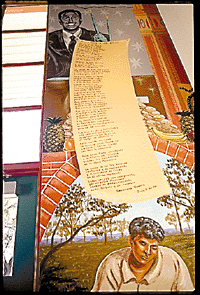 Fidencio Dur�n mural in Parque Zaragoza Recreation Center building |
found objects, greet visitors as they enter the rotunda. It is a castle-cool
space made of stone. Priour’s work is also cool. Blue and green glass vials and
vessels containing found objects are suspended from the ceiling and perched
atop carved limestone pedestals mounted high on the wall. In the AIPP guide, a
small gold square indicates that this art was “created with community
participation.” In this case, that means homeless people who aided the artist
and were paid by him to gather “stuff” for the vessels from the shores of
Waller Creek. But Priour’s thoughtful notion to include people who had been, in
a sense, displaced by the Convention Center was off-putting for some citizens,
who tried to stop the project. Letters were written, people took sides. And
then, as suddenly as the noise began, it was over, and the artist’s incredibly
complex and quite beautiful installation was complete. “There’s no
predicting….”
Sandra Fiedorek had a similar close call last November when a newly configured
Airport Advisory Panel attempted to have the city council revoke approval of
the artist’s proposed mural for the new airport. Even though Fiedorek’s
proposal had been one of the top four selected through an intricate process
(involving approval by a specially appointed AIPP jury, the Airport Advisory
Panel, the Austin Art Commission, and an earlier city council), it was suddenly
in danger. Some lobbying of councilmembers by the artist and an effort to
quickly educate those concerned saved the day.
Priour’s proposal, on the other hand, generated so much press over time, that
he bound the articles together and put them in one of the hanging glass
bowls in the convention center. In other vessels are spectacles, a high-heeled
shoe, a baby shoe — remnants and reminders of lives that have been lived in
Austin.
It is this ability of artists to embody the spirit of Austin through public
art projects that keeps the tiny AIPP staff going. Peters and a half-time
assistant, Julie Butridge, who also programs the Dougherty Art Center gallery,
clearly feel their efforts are worthwhile. “If a government forgets to
encourage cultural development, there’s no soul,” Peters says. One percent of
the budgets for certain city building projects seems like a small price to pay
to enhance Austin’s soul — and, subsequently, our own.
This article appears in March 7 • 1997 and March 7 • 1997 (Cover).