

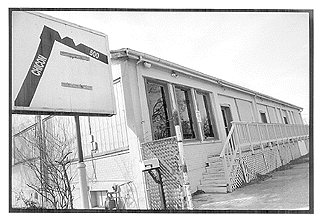
 An all-male “health spa” may open at this site in the heart of East Austin. photograph by Shelley Wood |
Orta is worried. After 15 years of plague, he fears that too many fellow gay men are slipping back into behaviors that helped
lead the community into the darkness of AIDS in the late 1970s and early 1980s.
So when he discovered last summer that a gay bathhouse was opening in Austin,
Orta knew he would have to fight it. Referring to the bathhouse — Midtowne Spa
on Airport Blvd. — as a potential “HIV incubation factory,” Orta called on the
gay community to insist that management there provide safer-sex education and
prevention materials to customers and allow AIDS outreach workers into the
facility.
But when Orta was told last fall that a gay bathhouse might open at 500 Chicon
— in the heart of Hispanic East Austin and just around the corner from
Informe-SIDA, an AIDS prevention and education organization that he directed at
the time — he began organizing opponents in an effort to keep that facility
closed.
San Antonio resident John Baley and other investors in that East Austin
facility, Alternative Clubs Inc. (A.C.I.), say the club will be simply a health
spa where gay men can socialize in an alcohol-free and sex-free environment.
But Orta and others say they don’t believe Baley, and they have helped make
A.C.I. the main focus of a growing controversy over bathhouses in Austin’s gay
and AIDS communities.
Orta says he has several concerns, including the location of A.C.I. behind a
Catholic family center and near an elementary school and a residential area.
But he also fears the image A.C.I. — and gay bathhouses in general — might
give the gay community, especially in the culturally conservative Hispanic
community. “Do we really want to promote the gay and lesbian community as
people who want to have anonymous sex?” Orta says, pointing to stereotypes of
gay men as sexually irresponsible or, worse, as sexual predators.
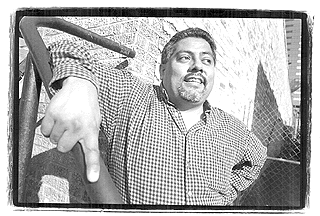 Jos� Orta photograph by John Anderson |
and he says he knows that danger from personal experience. Orta discovered he
was HIV-positive in the late 1980s, and he is convinced he was infected during
a visit — as an intoxicated and closeted gay man — to a bathhouse. Often, he
says, gay men who are struggling with their sexuality engage in anonymous sex
with other men — and often such encounters are facilitated by alcohol or drug
use. Having a bathhouse to visit just makes it easier to make unwise and unsafe
choices.
“It’s like opening up a free-beer place next to where an AA meeting
congregates,” Orta says.
Strange Bedfellows
Orta has gathered considerable support in his fight against A.C.I., includingfrom leaders in Austin’s Hispanic community. Cathy Vasquez-Revilla,the
publisher of La Prensa, a community weekly, and secretary of the Austin
Planning Commission, says she is not surprised Orta has sought help from others
in the Hispanic community — many of whom, because of their conservative,
religious views on issues such as homosexuality, are not often seen as friends
of the gay community. “I think Jos� knows… that lots of minorities are
affected by AIDS,” Vasquez-Revilla says. “I think he’d reach out to the devil
if he needed to, to keep more people from our community from dying.”
Vasquez-Revilla knows that finding opposition to a gay bathhouse in East
Austin will be easy. She says East Austin residents see the potential that a
gay bathhouse might open in the neighborhood as a slap in the face. “It’s like
the supreme insult,” Vasquez-Revilla says. “It’s going to be viewed as a white,
outside gay business coming in to pollute in a whole other way — in a moral
way.”
In fact, the controversy over A.C.I. helped persuade East Austin residents to
push (successfully) the Austin City Council in December to pass a moratorium on
most commercial permits in an area bounded by I-35, Airport Blvd. and Town
Lake. The effort to pass the moratorium had gained momentum after a July fire
at the site of Browning Ferris Inc.’s East Austin recycling plant and the
opening of the Balcones Recycling Co. facility in the neighborhood angered
residents frustrated by the location of potentially dangerous, and what they
consider undesirable, businesses in the community. A.C.I. simply added another
issue for East Austin residents to be angry about, Vasquez-Revilla says. “It’s
the straw that’s going to break the camel’s back,” she says.
However, the moratorium, which is scheduled to expire in late January, will
not affect A.C.I. because the facility has already received its permits to
operate. And when A.C.I. opens for business (which Baley says should happen
before the end of this month), Vasquez-Revilla says her worries will move
beyond simply the issue of locating undesirable businesses in East Austin.
Vasquez-Revilla says she also is worried that patrons of A.C.I. will become
targets of gangs that already exist in the East Austin. “There are gangs over
here who are killing each other, and now they’ll have another target,” she
says.
A.C.I.’s Baley, however, insists that such concerns are unfounded because
patrons of the club will be provided safe and secure parking in a fenced lot at
the site. Baley also says none of A.C.I.’s neighbors have approached him with
concerns about the facility. “We’re just quiet, peaceful neighbors to
everybody,” Baley says.
Apparently, Baley hasn’t met Deacon Willie Cortez, the director of Our Lady’s
Family Center, a Catholic lay organization next door to A.C.I. Cortez has
worked with Orta to organize opposition to A.C.I. by bringing dozens of
community residents to Austin Planning Commission and community meetings on the
subject. Cortez says he worries how he will keep curious children from the
family center away from A.C.I.’s property, and he is concerned that negative
stereotypes about gay men visiting the club will scare off patrons and
employees of the family center.
Cortez also says he is quite comfortable working with Orta, an openly gay man
he calls a friend. “I don’t agree with everything [Orta] believes, and he
doesn’t always agree with everything I believe,” Cortez says. “But I believe we
have enough in common to be able to work back and forth with each other.”
A Steamy History
Orta’s concerns about A.C.I. are fueled in part by the history of gay baths.Gay bathhouses were particularly popular in large cities in the 1970s and early
1980s, a time when a night at the baths was in some ways a political statement
— an almost total rejection of societal taboos that gay men found oppressive.
In a society where gay men were arrested and beaten because of their sexual
orientation, a man could rent a locker or cubicle in a bathhouse for a few
bucks, then wrap himself in a towel and scout out the halls for prospective sex
partners.
Then came AIDS. Bathhouses did not cause AIDS, but the availability of
multiple sex partners at the baths surely facilitated the spread of the virus.
As it became apparent that HIV, the virus that causes AIDS, could be spread
through unprotected sex, officials around the country targeted bathhouses and
other sex clubs for closure. In 1985 in Boston, for example, police wielding
sledgehammers raided and tore down a gay after-hours sex club. The San
Francisco health department, in the midst of heated debate within the gay
community, closed that city’s 14 bathhouses in 1984.
In Austin, the last bathhouse closed around 1985 after fear of AIDS kept many
men — and their money — away, says Jim Thurman, who moved to Austin from San
Francisco in 1983 and who today publishes Positive Threads, an
Austin-based monthly newsletter for people with AIDS. “What happened here is
that nobody went [to the baths] because they didn’t want to get [AIDS],” says
Thurman, who has joined Orta in opposing bathhouses in Austin. “It wasn’t the
pressure that shut them down here. It was the lack of business.”
But today, more than a decade later, AIDS educators fear that a new generation
of young gay men sees AIDS as a distant threat. And perhaps the long years of
living with the plague have beaten back the fear and worn down the resolve that
once pushed bathhouses onto the back roads of the gay community. For whatever
reason, the baths are back.
Some bathhouses actually have survived the plague. Bathhouses in Dallas,
Houston and San Antonio, for example, have operated throughout the years of the
AIDS epidemic. In fact, Baley also is an investor in an A.C.I. facility in San
Antonio. (It’s worth noting that Midtowne Spa’s location on Airport once housed
the Frog Pond, where straight men could rent hot tubs and entertain lady
friends. In addition, several other Austin businesses currently are basically
commercial sex establishments for straight men and women.)
Don’t Close: Educate
Orta’s and Thurman’s opposition to the baths has been met by criticism frombathhouse owners and from other members of the city’s gay and AIDS communities.
One of the owners of Midtowne, Mike Zappas, argues that the key to fighting the
spread of AIDS is personal responsibility, not closing bathhouses. He also
points out that “there is nothing that takes place at Midtowne that doesn’t
take place in every hotel.”
A.C.I.’s Baley, on the other hand, refuses to call his facility a bathhouse,
and he has repeatedly said that his club’s management will not permit sexual
activity at the site. But Orta says a man identifying himself as an A.C.I.
investor called the Austin Latino/a Lesbian and Gay Organization (ALLGO), the
parent organization for Informe-SIDA, last fall and asked what could be done to
keep ALLGO from opposing the opening of A.C.I. as a bathhouse. And the same
individual, Wayde Frey, an employee of Huston-Tillotson College (which is
located near A.C.I.), told The Texas Triangle, a gay weekly published in
Austin, that investors would not publicly call A.C.I. a bathhouse because
“that’s the way it’s done in Texas. It’s a matter of survival,” he said.
In any case, Baley says an important issue in the whole debate is who makes
decisions about personal behavior and which businesses people may patronize.
“It’s not right for an individual standing off to the side [to be] making
decisions for other people,” Baley says. “Maybe adult American citizens can
decide for themselves.”
Other Orta opponents in the gay community have been more blunt in their
criticism, Orta says. “I’ve had people give me the finger,” he says. “I’ve had
people call me names: `sex nazi,’ `faggot hater,’ `old queen that can’t get
anything at the bathhouse and that’s why I want to shut it down’.”
And Orta has some critics in the AIDS community who, far more respectfully
than some of his opponents, say that the proper debate should be over how to
educate people about how to avoid HIV infection, not whether to tell people
where they can and cannot have sex. Oscar Lopez, a public health program
specialist for the Austin Health Department who collaborates with AIDS
organizations that specialize in working with men who have sex with men, says
he thinks AIDS educators need to focus on getting people to modify their
behavior and to follow safer-sex practices. “Our mission is not to be deciding
where they are having sex,” Lopez says. “That’s none of our business.”
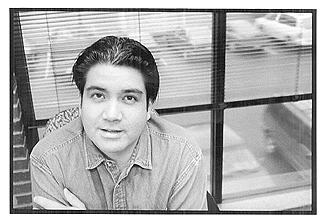 Oscar Lopez photograph by Shelley Wood |
to set up AIDS education and prevention programs at the bathhouse, Lopez says.
Indeed, doing so is more than just responsible, it’s good business, says Bill
Zappas, Mike Zappas’ father and a co-owner of the Midtowne chain, which
includes clubs in Dallas, Houston, and California. “It pays for us for our
customers to stay alive — to be safe and remain healthy,” Bill Zappas says.
(A.C.I. has not developed similar programs for outreach workers because the
owners insist it is not a bathhouse, Lopez says.)
Lopez also says that bathhouses may actually help AIDS education and
prevention programs reach some men who might never have been exposed to such
programs. Bathhouses, he says, provide men who don’t self-identify as gay —
men who might otherwise live strictly heterosexual lives but who are sexually
attracted to other men — a safe location to explore sex with other men without
risking arrest or physical safety at public parks or in adult bookstores and
other sexually oriented businesses. “It’s a whole new opportunity for us to
work with men who we haven’t been able to get to at our other venues,” Lopez
says.
Government Wades In
The bathhouse debate also has captured the attention of government officials,including state Rep. Glen Maxey, the state’s only openly gay legislator, whose
district includes the neighborhood surrounding A.C.I. In November, Maxey joined
other A.C.I. opponents in demanding that city officials address the issue of
bathhouses. At a November 26 Austin Planning Commission meeting, Maxey charged
that A.C.I.’s investors had fraudulently applied for a permit to operate the
club as a health spa while intending to operate it as a bathhouse.
“This is a sex club,” Maxey bluntly told commissioners. “This is a place where
people meet to have sex.”
Maxey since has clarified his position, however, saying that he does not
oppose bathhouses in general. The issue facing Austin, he says, is how
bathhouses are to be regulated to protect their patrons and to keep them out of
neighborhoods where they are not compatible with existing development. “I have
not taken and do not take absolute opposition to well-regulated, well-organized
health clubs that may even have sexual activity inside,” Maxey says.
But city officials have expressed confusion in deciding how to define
bathhouses, much less how to regulate them. In fact, city officials say that
Austin’s ordinance covering sexually oriented businesses does not even mention
bathhouses because such businesses did not exist here when the ordinance was
written in the late 1980s. City officials also say that currently there is not
much they can do unless Austin police document sexual activity at A.C.I. or
Midtowne Spa. Such activity would violate the businesses’ permits to operate as
“health clubs” and could lead to their closure.
In the meantime, city officials are scrambling to draft a new ordinance that
addresses and defines bathhouses. City planning commissioners are awaiting
staff recommendations on such an ordinance, and Trey Salinas, council aide for
Mayor Bruce Todd, has said that the City Council might have to move quickly to
address the issue.
Regardless of when A.C.I. opens or how fast the city passes bathhouse
regulations, opponents of the facility say they will keep up the fight. That
fight might include vigils and pickets when the facility opens, they say.
Meanwhile, Orta has been left wondering whether the battle over bathhouses has
been worth it for him personally. Declining health and the stress caused by the
controversy helped persuade him to leave his position at Informe-SIDA last
fall, he says.
Nevertheless, Orta says, he would still take on the issue if he had to do all
it over again. “Once I tested positive, one of my jobs was to stem the spread
of HIV,” he says. “And I took the only stand that I could live with.”
Dan Quinn is managing editor of The Texas Triangle.
This article appears in January 24 • 1997 and January 24 • 1997 (Cover).