





It’s hard to argue against the notion that Austin has one of the strongest civilian police oversight systems the city has ever seen – perhaps even one of the most robust in the nation.
On paper, at least.
Equity Action, the justice advocacy organization that wrote the voter-approved Austin Police Oversight Act which serves as the underpinning of Austin’s current police oversight system, believes so strongly in the ordinance’s power that they are currently suing city officials to force them to fully implement it.
On the other end of the oversight tug-of-war, the Austin Police Association has been so resistant to full implementation of the Oversight Act that they have been willing to forgo a labor contract – and the guaranteed raises and financial incentives that come along with it – to try to kill, or at least neuter, the oversight system.
But Austin is lagging in key metrics that would show the oversight system is working as designed, such as the number of community complaints the Office of Police Oversight (OPO) investigates. Since the beginning of the year, the police chief has suspended just one officer (suspensions are one of the most severe disciplinary actions the chief can take; typically there are 10 or more in a given year). The Community Police Review Commission (CPRC) – a volunteer board tasked with providing additional oversight above OPO – is nonexistent, despite being a requirement of the Oversight Act.
Some of these results are due to legal constraints. The CPRC could begin meeting, for example, but it cannot fully investigate complaints against officers unless that authority is negotiated into a labor contract with the APA (per an April 26 memo, OPO expects to begin appointing commissioners soon and training them in September). Some results are due to the city’s unwillingness to fully enforce the Oversight Act (until recently, OPO did not have full, direct access to APD records required for the agency to conduct independent investigations of complaints).
But could the lackluster numbers reflect pro-law-enforcement bias? It’s a fear that oversight advocates have held for years, as Kathy Mitchell, Equity Action adviser and longtime police oversight advocate, told us. OPO is designed to act as a voice for the community in an accountability system that already works in the favor of officers. OPO personnel should bring a civilian’s perspective – informed by community values – when assessing officer conduct during an investigation and making disciplinary recommendations, Mitchell said.
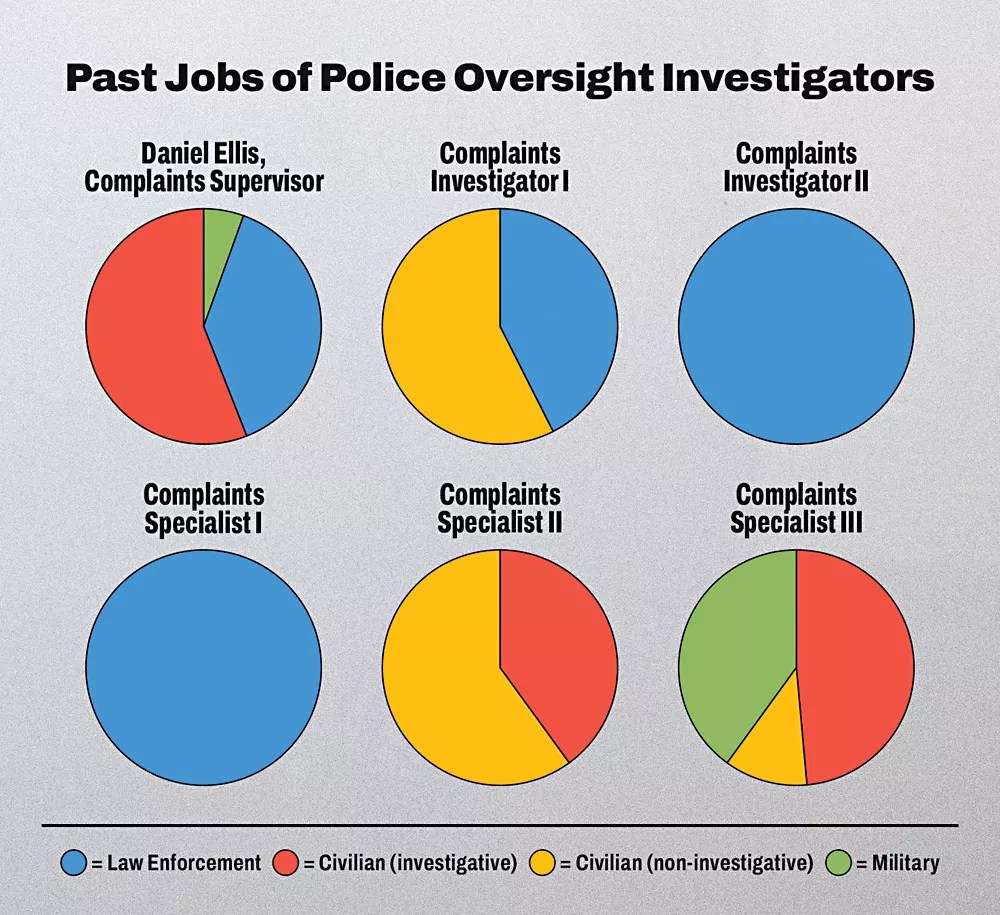
Determining an individual’s specific biases is not straightforward, but looking at their chosen careers might offer clues. A review of the work histories of the six individuals staffing the complaints division at OPO – where allegations of officer misconduct are collected and investigated – reveals that five of them have spent significant portions of their working lives in law enforcement or in the military.
“Civilian oversight is a very difficult job because you often feel like there are no friends. if you’re doing your job well, there is always someone – city manager, police chief, community members – who is unhappy.” – Civilian Oversight Expert Cameron McEllhiney
Daniel Ellis, hired by OPO Director Gail McCant late last year to supervise the complaints team, has spent 44% of the 56 years of job history he reported on his OPO application working in law enforcement or military roles. One of the two investigators hired to lead OPO investigations into alleged officer misconduct has spent 42% (about 10 years) of his career in law enforcement; the other investigator reported eight years’ worth of jobs – all of which were law enforcement. Of the three complaints specialists hired by McCant, only one has had no law enforcement or military jobs. (The review is based on copies of applicant résumés the Chronicle obtained through public information requests; of the complaints team employees, we have chosen only to name Ellis as he is the division’s highest-ranking employee.)
Mitchell said the findings were disturbing. “The most important value for OPO is independence from police,” Mitchell said. “Staffing up with people who emerged from law enforcement does not give them the independence they need to advocate for the truth that has been presented by witnesses and victims of police misconduct.”
But national police oversight experts say hiring people with law enforcement backgrounds to conduct oversight does not necessarily mean investigations will be biased. “I understand where the community concern around hiring former law enforcement comes from, but it’s not an uncommon practice,” Cameron McEllhiney, executive director of the National Association for Civilian Oversight of Law Enforcement, told us. “As long as they are conducting thorough, fair, and unbiased investigations.”
Typically, McEllhiney said, oversight investigators come from one of three jobs: private investigator, law enforcement, and employment investigations. Some of OPO’s complaints team worked in jobs that could be described as civilian-investigative – such as the 12 years Ellis spent working in the U.S. Department of Housing and Urban Development’s Office of Inspector General.
OPO declined to answer our questions about some of their employees’ work histories, so the nature of some of these jobs is unclear. However, a 2007 HUD OIG report – published during the period Ellis worked there – says a Special Agent Daniel Ellis presented on initiatives “addressing violent crimes and fraud” in public housing developments and other work involving collaboration with law enforcement agencies.
McCant declined an interview request but responded to some of our questions by email. “OPO staff are required to be impartial and unbiased in their work,” McCant said in response to a question about the professional backgrounds of her complaints division. “Staff do not operate unilaterally at any level and are supervised by experienced administrators and oversight practitioners to ensure transparency and accountability.”
When asked what professional characteristics or specific experience she was looking for in hiring for the three complaints roles, McCant linked to the description for each job and to a web page that describes the city’s competitive hiring practices.
“Transparency is critical to OPO’s role,” McCant said when asked about how the city could reassure community members concerned about her staff’s investigative work. She added that the agency shares as much information with the public as is allowed under state law – including some disciplinary documents.
McEllhiney told us running a civilian police oversight agency is a delicate balancing act, one that requires its practitioners to be deeply committed to the mission of oversight – and to constantly advocate for it.
“Civilian oversight is a very difficult job because you often feel like there are no friends. if you’re doing your job well, there is always someone – city manager, police chief, community members – who is unhappy,” McEllhiney said. “A key part of oversight is constantly advocating for the agency and its authorities. There’s never a moment you have a break from that.”
This article appears in August 23 • 2024.