



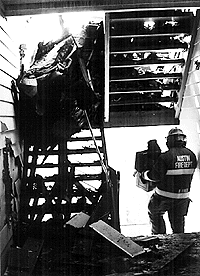
 An Austin firefighter helps residents salvage property that was not lost to fire or looting at Centennial Condominiums |
Lisa Cashiola’s mother had not called to chat late that Friday night, Cashiola, 20, probably would have been
asleep when the screaming started. The Centennial Condominiums, where she lived
in the West Campus neighborhood near the University of Texas, was normally
rowdy on the weekends, but these weren’t the usual partying students she was
hearing, these were screams of panic. Cashiola had no other warning of the
inferno tearing through the third floor of Centennial until she walked outside
to see the apartment above her own in flames. No fire or smoke alarms had been
sounded and no sprinkler system was installed to squelch the rapidly spreading
fire. Turning to grab her wallet, Cashiola ran down the outside stairs to the
street. “I had the feeling when I left that that was it. Everything was gone,”
she recalls.
The December 14 fire at Centennial Condominiums displaced 225 renters and was
the most costly residential fire in Austin history, with loss estimates of
$15-20 million. But while the origin of the fire remains a mystery, the cause
of its destructive power and deadly speed does not. Although rent ranged from
$1,200 to $1,600 for two- and three-bedroom apartments, luxury prices didn’t
buy residents any added safety. Lacking adequate firewalls, sprinkler systems,
and a multi-unit fire alarm, the building still conformed with the fire safety
code under which it was built in the early 1980s, and therefore violated no
laws.
However, combining shoddy design, lax construction standards, and virtually
non-existent property management with the missing safety features turned what
should have been a small fire into a disaster zone. Centennial “was not built
to slow down fire, so therefore it burned fast,” says Captain Doug Fowler of
the Austin Fire Department, who headed up the investigation into the Centennial
fire. He adds that it was just a matter of time before such a tragedy occurred
at the building.
As if the trauma of the fire weren’t enough for Centennial residents to
endure, the disorganized circus following the fire served to add insult to
injury. Renters, forbidden to enter the property for nearly a month pending
investigations, were assured by Centennial representatives that
around-the-clock security would protect whatever belongings the fire had not
destroyed. On January 11, those residents who were lucky enough to have lived
in the 26 of the building’s 76 units which were not completely destroyed were
escorted by Fire Department personnel through the building to retrieve their
remaining personal items.
While the Statesman and local radio were content to report that happy
residents spent a chilly Saturday retrieving their valuables from the ruins of
Centennial, the reality of the scene that day did not present such a rosy
picture. Many residents were furious upon finding that they had lost as much
property to looters as to the fire itself. “It’s not accurate that everyone was
happy,” says UT student Scott Lydick, 19, who had two tents, power tools, and
electronics stolen. The looters “were very selective,” he notes, “so they must
have had plenty of time.”
One 20-year-old resident, who did not want to be named, lost her VCR, stereo,
and jewelry to looting. She said that she was especially disturbed to discover
that her apartment had satanic scriptures spray-painted on the walls and
condoms and beer bottles laying on the floor. “We wanted closure and what we
got was another drama when we went in there,” she fumed.
UT student Dee Campanella, 19, points out that only a third of the units
could even be entered at all, adding that she knew one resident who was only
able to salvage a charred potted plant from her burned and looted apartment.
“It really just makes you sick,” was her comment on the light-hearted slant of
local press coverage.
Larry Neimann, legal representative for the Homeowners’ Association, which
represents the condo owners — not the renters, who comprised the majority of
Centennial tenants — says that the group did the best it could to insure that
renters’ belongings would be protected. “We had 24-hour security, but it’s not
like it was Fort Knox,” he says. “I don’t know how much more we could do other
than stand out there ourselves with a shotgun.” He adds that the homeowners
cannot be guarantors for renters’ property under any circumstances.
Carol Wolf, who manages the Homeowners’ Association, tells a slightly
different story. “The purpose of security was to keep people out of the
building, not for the purpose of protecting stuff,” she says. Neimann points
out that because the building was so destroyed, allowing renters to retrieve
their belongings without first assessing which parts of the building were safe
to enter would have risked lives.
Some former Centennial tenants also complain that there appeared to be no one
in charge of answering tenants’ concerns. The Homeowners’ Association kept a
master list of landlords, but because each apartment was rented separately from
its owner, there was no such master list for renters. When the fire was over,
there was no contact number for burned-out renters to call and no one
dispersing information to them from the fire department. Resident Kathy
Williams complained that Wolf would not return phone calls after the fire.
“Communication was really poor on all levels,” adds resident Susan Petit, 20.
“We wanted to know about the investigation, we thought we had the right, but no
one made any effort.” (Follow-up calls to Wolf from this reporter were not
returned.)
Theories abound as to the fire’s cause, running the gamut from an improperly
discarded cigarette to gutterpunks lobbing molotov cocktails at the building,
but AFD has yet to determine how the fire started. However, there is little
doubt about where and how the fire spread. AFD had been to Centennial earlier
on December 14 to extinguish a fire in the trash chute, and even waited for two
hours to make sure that it did not restart. However, six hours after
firefighters left, an ember from the earlier fire reignited and, because of the
building’s construction, was able to spread undetected through its interior
walls. Centennial is built with “balloon construction,” meaning that there is
open space between each of the apartments which runs the entire height of the
structure, and which AFD Captain Fowler calls “an inferior way of building.” In
addition, there were no sprinklers and no firewalls to divide the massive
common attic which ran the length of the building. The combination of these
features meant that the fire could run through the building vertically and
horizontally before ever igniting apartment walls and thereby helping to alert
residents.
In fact, even when apartment walls caught fire, there were no sprinklers
installed to squelch it, and many residents say that they were not warned by
their smoke alarms. By the time anyone knew that a fire had started, the
building was already engulfed in flames. Furthermore, poor building design
would not have been an issue if the scant fire safety equipment that Centennial
did have had been functioning. The trash chute was equipped with a sprinkler
system, as required by law, but it had been turned off. Furthermore, the chute
was required to be built with drywall surrounding it to help prevent trash
fires from spreading, but AFD says that there was no drywall there.
Despite the safety lapses, AFD does not plan to issue citations for these
violations because the small fines they would be able to impose — only a few
hundred dollars — would make little punitive impression. The multiple
ownership of the complex means that no one person can be made responsible for
the violated fire codes.
So while former Centennial residents search for new homes, there have been a
few positives — like the chance to pay cheaper rent. The majority of
Centennial residents were students living on their own for the first time. “I
didn’t know what you could get for that money,” says Finance sophomore Lydick,
who paid $1,600 a month for a three-bedroom apartment at Centennial. “Now we’re
looking at it going `That place was a dump.'”
Lydick contends that Centennial landlords “played a little bit on our
na�vete” in renting the high-priced units with few amenities other than a
dishwasher and proximity to the UT campus.
Another former tenant adds that her new landlord was quick to point out
sprinklers and firewalls, along with a gym, sauna, and other luxuries that she
and her roommates now enjoy at the same price they paid at Centennial. Although
resident Missy Marks is resettled now and reimbursed by insurance for her
property losses, she, like many former Centennial residents, is still bitter
about the experience. “This has been a major setback,” she says. “I wouldn’t
say that anything good has come out of it.” Then again, the fact that she’s
alive is a bit of a miracle.
This article appears in January 24 • 1997 and January 24 • 1997 (Cover).