

Almost 40 years ago, folklorist Alan Lomax embarked on two journeys
through America’s Deep Sout@  � <  en-state-of-the-art recording equipment, he sought
out pockets of civilization that were still untouched — or at least unaffected — by the
pervasive influence of mass media. And he found them.
Lomax discovered people who, when they wanted music, pulled a fiddle down
from the shelf or dragged a guitar out from under the bed instead of turning on a
radio. He found folks playing songs that had been passed down from generation to
generation. He found musicians who could hold their own against the best Chicago bluesmen
or the hottest pickers in Nashville. Most of all, he found true folk music, not
the commercialized tunes being sung by the Kingston Trio, the Chad Mitchell Trio,
or any of the other groups that were in vogue at the time.
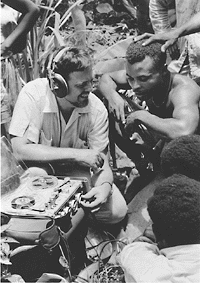 Lomax recorded more than 80 hours of folk, blues, country, and
gospel music on his trips through Virginia, Kentucky, Alabama, Mississippi,
Arkansas, North Carolina, Tennessee, and the Georgia Sea Islands. Some of that music was
issued in 1959 on a 12-LP set by the Prestige label, but now the bulk of that material
has been remastered and is being released as The Alan Lomax Collection:
Southern Journey, a 13-volume set from Rounder Records. At present, the first six CDs in the
series, plus a sampler disc of the entire collection, are available.
But the Southern Journey series is just the tip of the Alan
Lomax Collection iceberg. During his career, Lomax made several trips throughout the United
States, Great Britain, Europe, and Asia, capturing the indigenous music of native
peoples. In what is perhaps the most ambitious reissue program ever attempted, Rounder
will be releasing almost all of that material over the next five years. All told,
The Alan Lomax Collection will number some 100 compact discs.
“We couldn’t put them out all at once, because it would be
unfeasible,” says Bill Nowlin, co-founder of Rounder. “It would be pretty
spectacular, but not too many people could afford to buy them all. That’s probably going to be
true over the years, too. But if we put out 10 to 20 over the year, it might be a
little easier for people to handle. My guess is that within the first five years,
we’ll see most of them out. But it’s pretty hard to know when it’s going to stop
because they keep finding new things.”
A Family Affair
The first key figure in documenting American folk music was Alan’s father,
John Avery Lomax. As a child, growing up in the tiny Central Texas town of
Meridian, John Lomax began writing down the words to the songs he heard the cowboys sing as
they drove their cattle along the nearby Chisholm Trail. Later as an academician,
John Lomax launched a nationwide search for folk songs.
“Actually, with father, it started out to be the poetry,” says
Bess Lomax Hawes, Alan’s sister. “He thought about the songs — as most
folklorists of his day did — as the words being more important than the music…. He was
something of a populist all his life and he felt that ordinary people had poetic
contributions to make. He thought that this material was very interesting, very worthwhile,
and very beautiful. As he went along, he began to appreciate the music more. Then
it became possible to record the music.”
John Lomax realized that these songs were more than just words — they
needed music to bring them to life. And while traditional musical notation could be
used to represent the melody, there was more in the way these songs were performed
than could be captured on a five-line staff.
To alleviate this problem and to preserve the performance as well as the
song, John Lomax began recording his subjects in the field as early as 1907, first
using wax recording cylinders and later wax or acetate discs. Alan Lomax began
accompanying his father on these trips in 1933. The Lomaxes were the first to record
Leadbelly while he was serving time in a Louisiana prison, and according to the legend,
facilitated his release. Alan took up the mantle himself, recording several historical
sessions with Leadbelly, Woody Guthrie, and Jelly Roll Morton for the Library of
Congress in the late Thirties and early Forties. During a 1941 trip to the Mississippi
Delta in an attempt to record Robert Johnson, who it turns out had died three years
earlier, Alan Lomax discovered Muddy Waters and Son House.
“We tried to find a way to let people who didn’t have very big voices
let their ideas out and get them spread around — let them say what they wanted
to say,” says Hawes, who helped popularize folk music during the Forties as a member
of the Almanac Singers, which also included Guthrie and Pete Seeger. “[My
father, Alan, and I] worked rather differently, but I think all three of us had the same
basic goal…. Music always happens in connection with important things. People are
always trying to squash it, trying to silence it, particularly in political
situations. There have been many attempts to outlaw this or that kind of music. For that
reason alone, you have to think about how important music must be.”
Field Recording
Alan Lomax had a great ear for a good song and a knack for finding
outstanding artists. As the recordings testify, he also had a proclivity to draw the best
performances out of a musician.
“Alan has a way of persuading musicians that he is listening to them
like no one ever listened to them before,” says Hawes. “He has always
had that capacity to make musicians feel good. A lot of time, recorders are trying to
be neutral, the way they told you to be in anthropology classes. That’s not what a
musician wants. A musician wants somebody to say, `Hooray. Oh God, isn’t that beautiful.’
That’s what Alan would do … he came on like a real human being to these musicians
and they really liked singing for him. If you go into the Library of Congress and
listen to recordings done by other people, I just don’t think they have the joy and
excitement that many of Alan’s recordings have.”
“My father just got down to where the people were,” says Anna
Lomax Chairetakis, co-producer of the series. “He drank with them, he sat with
them, he went in their boats and recorded them. He was interested in everything
they did and asked all kinds of questions. He just made people feel good.”
Chairetakis says her father didn’t begin a song-gathering trip without a
plan. “It wasn’t like he was wandering along and picking flowers on a country
picnic,” Chairetakis says. “He usually had a purpose, and as his career went on,
his purpose became more and more meaty — or juicy if you will. When he first
started collecting with his father, they were trying to identify a body of music
among African-Americans in the South that they felt was uniquely theirs — that they had developed
and not been recognized, but yet it was part of the American folk song tradition.
That was one purpose they had, but as he went on, he began looking for more and more
things.”
According to Chairetakis, being recorded inspired many of the musicians to
become more introspective about their songs and their place in history. She says
others used the opportunity to reach out to the world in a time when communication
was limited.
“They felt like they were connecting from their places of relative
isolation,” Chairetakis says. “Alan talks about how one of the people he recorded
just took the microphone and started talking directly to President Roosevelt, saying,
`Hello, this is how things are for us down here and we’re really happy we can talk to
you,’ because Alan was coming from the Library of Congress.”
Lomax took care to get the best recording he could, sometimes under
difficult conditions. When traveling the South during the age of segregation, he was
often hauled off to the police station and told he shouldn’t be associating with
“Negroes.” Some feared he was stirring up trouble among the blacks, while others didn’t
want to admit that African-American culture was something worthy of study.
However, says Chairetakis, Lomax encountered little suspicion from the African Americans he
visited.
“Blacks were really happy that somebody was interested in their story
and who they were and what they had to offer,” explains Chairetakis.
“Not interested in it in terms of making money like the race record companies and exploiting
them, but really interested in documenting this and incorporating that into a
picture of understanding the music they were performing.”
By the People,
For the People
Much of the music Alan Lomax recorded has been made available previously.
Selections of his Library of Congress Recordings of Woody Guthrie and others have been
released on various labels since the Forties and are currently available on Rounder.
Some of the Southern Journey material has been available before as well;
Lomax worked with Columbia Records in the Fifties to produce a 40-volume set of
world music, although only 18 albums were actually released. He produced several radio
shows featuring this music and collaborated with his father to publish several books of folk
songs. The Lomaxes weren’t content to merely collect songs, though; they wanted to
ensure that those songs were sung.
“They popularized this music, to some extent, as opposed to just
documenting it,” Nowlin says. “I think there was probably a concern that if it
was simply hauled away into an archive, it would become archived and protected,
but it wouldn’t actually get out to the people. I think that was the reason a more
commercially oriented — not that we’re Sony Records or anything — but a more
commercially oriented outfit would be a better place [than a museum or university].”
Chairetakis says her father is pleased with Rounder’s commitment to
release all of the material and keep the discs in print. Lomax suffered a stroke last
year and has been unable to direct the project, but has final approval.
“He believed that this music was our patrimony for the whole human
race,” Chairetakis says. “We needed to keep it alive and we needed to know
about it, and if possible, keep it alive through living musicians. One reason he was so
bent on popularizing and getting things out in the media is because he felt it was
a form of feedback to the people whose music this was — that they would be
encouraged to continue with it.”
Southern Journey
On the Alan Lomax Collection Sampler, Lomax tells interviewer
Charles Kuralt “… when you could play this material back to people, it changed
everything for them. They realized that their stuff and they were just as good as
anybody else.” That statement is proven time and again throughout the first six discs of the
set.
Volume 1, Voices From the South, features “blues, ballads,
hymns, reels, shouts, chanteys, and work songs.” Highlights include Sid
Hemphill playing the quills, a form of panpipes slaves brought over from Africa during the
19th century, an instrument thought to have been extinct. Volume 2, Ballads and
Breakdowns, focuses on music from the Blue Ridge Mountains and features many great
versions of classic story songs, like “John Henry,” “Old Joe Clark,”
and “Poor Ellen Smith.” Lomax’s recording of Texas Gladden lulling her
granddaughter to sleep with “Whole Heap of Pretty Horses” is especially touching.
Although recorded in 1959, much of the blues on Volume 3, 61 Highway
Mississippi, recall styles that date back decades earlier. Volume 3 has been perhaps the most
popular disc in the series.
Volume 4, Brethren, We Meet Again, is a trek through Southern white
churches, complete with spirituals, sermons, and the bizarre harmonies of Sacred Harp
singing. Anyone raised in the somewhat staid Protestant tradition might be taken aback
by the religious fervor of these backwoods congregations. For a contrast in
subject matter, Volume 5, Bad Man Ballads, is a collection of songs about
outlaws, murderers, desperadoes, and tragic heroes, many of which are sung by outlaws
and murderers who Lomax recorded on trips through Southern prisons. This disc
whets the appetite for future volumes of prison songs. Volume 6, Sheep, Sheep,
Don’tcha Know the Road?, brings sacred and secular traditions together,
highlighting the duality of Southern life by alternating the sweet sounds of gospel tunes with
ballads about lives turned to sin.
The sound quality on each disc is impeccable, since Lomax was one of the
first to use stereo magnetic tape. Oddly enough, this material was originally
released in mono, so those who have the old Prestige collection have another reason,
in addition to dozens of previously unreleased tracks, to pick up the new release.
A Living Document
Much of this music might have been lost forever had it not been recorded.
For the most part, music is not being handed down from generation to generation
like it once was. If you were to visit the most remote areas of the Deep South
today, your chances of finding a kid with a guitar trying to play the licks he
learned by watching Nirvana on MTV would be much greater than meeting someone playing
the songs he learned from his granddaddy or the old black man who lived down the road.
Economic, social, and political forces have changed America to the point where many of
the cultural differences that separated the urban and the rural no longer exist.
Television and radio now reaches into every nook and cranny of the country, often
drowning out regional musical styles in favor of the latest flavors being promoted by
multibillion dollar entertainment conglomerates.
Aside from being packed with fantastic music, The Alan Lomax
Collection is a vital historical document, not only because it preserves our musical
past, but because it can provide the foundation for the future. Lomax’s recordings of
Woody Guthrie were a touchstone for Bob Dylan’s career. When Miles Davis was
looking for material for his landmark Sketches of Spain album, he turned to
Lomax’s collection of Spanish folk songs. Music Lomax recorded has influenced and inspired the
likes of the Beatles, the Velvet Underground, Eric Clapton, Led Zeppelin, and
others whose influence and inspiration are still being felt today. Even Nirvana has
covered a Leadbelly tune.
Musicians faced with a lack of inspiration often talk about getting back
to their roots. Well, those roots are here, they run very deep, and they’re capable of
bearing new fruit.
This article appears in June 27 • 1997 and June 27 • 1997 (Cover).