

For
the last 11 years, people have asked the same question on or around March 16: “Who got signed?”
While the question naively implies that music industry movers and shakers just
hand out recording contracts like business cards at South by Southwest, it’s
not an entirely invalid inquiry. Artists do get signed as a result of SXSW.
It’s a fact, as is the reality that the majority of acts playing the conference
walk away virtually empty-handed. Like any other part of the music business,
SXSW is a big crapshoot. And it’s a lottery without printed odds.
Unfortunately, there are no real statistics as to how many acts have been
signed over the years as a direct result of the conference. And if there were,
how would one quantify that data? Does finding a lawyer, manager, booking
agent, or publisher at SXSW qualify? What about finding an indie home for your
band’s next 7-inch single? Conference organizers admit they’re equally
empty-handed when it comes to hard `n’ fast data. Every year, they send out a
follow-up questionnaire to the acts that played SXSW, but each year only a
handful are ever returned. Still, the number of talent submissions and music
industry registrants every year rises exponentially. Business must be getting
done in Austin, or perhaps there’s just a whole lot of executives with a gold
card to burn on hungry bands still holding out hope for a free barbecue dinner.
Either way, it wasn’t terribly difficult to conduct an informal poll of 12
indiscriminately chosen artists and get them to talk about their SXSW
expectations, experiences, techniques, and, yes, signing stories. Some found
deals at the conference while others have built a support team to get that
elusive record label contract. Other have used SXSW solely as a promotional
tool. Whatever the case, whether they’re international acts or hometown heroes,
the stories herein prove that there’s something to be learned about the
conference from its artists. Maybe this year, more acts will send back their
questionnaires. Meanwhile, here’s a few bands, their SXSW sagas, and their
answers…
The Old 97’s
As a solo folk artist, Dallasite Rhett Miller had played six SXSWconferences, and attended seven. “I got a lot of interest, but probably
rightfully so, they came out each year, saw me, and realized I was just a kid
not ready to take on that kind of obligation,” says Miller of his early SXSW
near-misses. “But I’m so glad. How much would that have sucked to blow my wad
as a 17-year old folkie?” Apparently a lot, because Miller and his alternative
country outfit, the Old 97’s, rebounded from several SXSW rejection slips with
a packed 1996 showcase that fueled an immediate industry frenzy, which resulted
in a multi-album deal with Elektra, starting with Too Far to Care due in
June. And while the previous two years of national touring and an indie album
on Bloodshot didn’t hurt their cause, Miller contends that it was a pre-SXSW
tour that brought them from the Gavin Convention in Atlanta, to a West Coast
run, and back to SXSW that really fanned the flames. “We didn’t really plan it,
but by the time we got to Austin there were five or six labels waiting because
they’d heard our name so much in the previous two weeks,” Miller says.
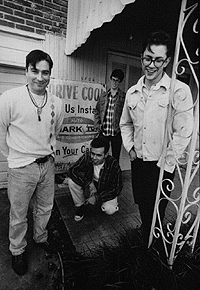 The Old 97’s |
you’ll be discovered out of the blue and that your show is going to be heavily
attended by very important people because they really care about new music.
None of that is really true. Your show is only going to be attended by
important people if other important people tell them to.”
The Austin Factor: “We couldn’t get the time of day from anybody in the
industry before we played the showcase. But it was good that we had played
Austin a couple of times and primed it a little, so that when we did the show
there was a packed house that included some actual fans. So they’d be singing
along and in the quiet parts you could actually hear them. And at the same
time, you could actually see the label guys looking at those fans and thinking,
`This has got to equal money.'”
The Weasel Factor: “Not only did I get the cards after the show, but I
got the whole `pull the lead singer off to the side and make friends with him’
thing. They think if they tell me really personal things, open up to me and
give me their home phone numbers, that it’s going to make me feel obligated to
sign with them or sell them my publishing. It didn’t work that way.”
[SXSW showcase: Thursday, Stubb’s, Midnight]
The Dangerous Toys
Since 1988, The Dangerous Toys have been widely credited as SXSW’s first realsigning story. In what was the conference’s second year, the Toys played the
Back Room’s last Sunday night slot to a crowd of ten. Frontman Jason
McMaster was at that point treating the band like the side-project it was,
and admits now that he was far more interested in playing with local
progressive metal outfit Watchtower than with this new boogie-influenced hair
band. But SBK Songs publisher Celine Armbeck was one of those ten people in the
crowd, and fell in love with the band. Soon after, while still trying to
convince McMaster to leave Watchtower, she began shopping for the Columbia deal
the band eventually went with. She found the deal, McMaster quit Watchtower,
and the band went on to sell over 700,000 units of their first two albums.
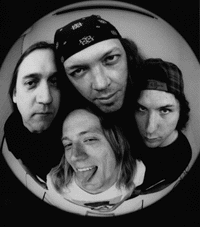 The Dangerous Toys |
still ask how we did it, and I’ve got to admit I didn’t even know what SXSW was
until somebody told me we were playing it. I didn’t give two shits because I
was in Watchtower. I was green. I didn’t know anything about the music
business. I was trying to make records with my friends at my own level. We
didn’t even have a demo, picture or anything. And I certainly didn’t expect
anything. Plus, we’d already played three times that week. So, we went out
there to the Back Room and drank. We said `fuck’ a lot, and it was a totally
shit gig. Then Celine comes right up to me after the gig and says `fuckin’
killer,’ blah, blah, blah. I’m like, `I’m not even in this band. You need to go
talk to them.’ I blew her off. I wasn’t trying to be a dick, but it was really
their band. And I was in a bad mood because I knew that everyone was right and
that I should take the Toys gig. But I was thinking about my friends in
Watchtower that I’d played with for seven years, trying to balance it all. It’s
kind of funny, because I did finally apologize to Celine after we got the
record deal. I said, `I think we need to start off again on another foot.'”
The Real Story: “There’s another part of this story. I guess I
can tell it now. Celine Armbeck actually came down here looking for Oynxx, the
girl that used to sing for the guys that were the Toys. They were called Oynxx
and [Armbeck] had been down for SXSW the year before and seen them play. When
she came back to see Oynxx again, it was with different people in the band.
There was no `Scottie Turbo’ or `Markie Starr,’ it was some other bad hair
metal players. She said, `this ain’t the same’ and asked Bobby McNeely, a local
guy that’s famous for being Peter Frampton’s tour manager, what the fuck’s
different about this band. He explained that the guys in Oynxx fired her and
she took the name, and they’ve got this crazy thrash metal guy fronting them
now. She wanted to check it out and stayed in town to see this band, the
Dangerous Toys. So the real story is that she got the news from a local and was
sent over. She was looking for something else and found me. Maybe the system
does work after all.”
Lisa Loeb
From 1991-1994 Lisa Loeb kept coming back to SXSW. While she admits she wasdisappointed by the lack of interest in her first SXSW performance, the New
York singer-songwriter says the networking experiences and seminar information
she picked up in the process more than paid for the trip. In 1993, returning as
a solo artist, Loeb continued to network, played a couple of hotel rooms, and
eventually met Jim Barber, a Geffen A&R rep who’d seen her showcase on a
tip from one of Loeb’s friends. Barber was impressed, took Loeb shopping at
Atomic City, and casually kept in touch with her throughout the year. But by
1994, the still-unsigned Loeb had landed a track, “Stay,” on the Reality
Bites soundtrack and returned to the conference to sort out a flood of
offers — many from people she’d met at previous conferences. The outcome? Loeb
got the crash-course in SXSW bidding wars she’d dreamed of two years earlier,
“Stay” went on to become a Number One Billboard hit, and Loeb settled on
Barber and Geffen after all.
 Lisa Loeb |
Expectations: “With Liz And Lisa [the first year’s duo project], there
were some record companies interested. I think we expected to go there, find
people really excited and sign us. We expected to be `discovered.’ But looking
back, it’s more important that when you get there, you do a good show and do
everything possible to get people to come see it. Because, at least from my
experience, it seems like there was never a discovery per se. I’d meet people
at different shows or at one of the hotels where everyone was hanging out. I’d
meet those music-business types and their friends, our mutual friends, and
simply try to get them to the show. We made sure we had plenty of tapes and
brought the fliers to pass around. Not so much to random people on the street,
but if you did meet someone you liked, you’d give them the flier to remind them
when you’re playing. Shameless self-promotion.”
The Austin Factor: “The key is that [all the A&R reps] are in the
same place at SXSW. There was a lot of access to them and so if you were
networking, it was easy to see one friend from New York, or even one person you
kind of knew and they’d introduce you to the four other people they were
talking to. Now, looking back to the year I got signed, it seems like there
were a lot more of the upper-level music business people I didn’t think I would
have been able to meet the first year I was there. I didn’t even know those
people were around really the first time. Maybe they weren’t…. I also met
people that might not have been in the top level of the industry but are the
ones doing a lot of the actual work — people that when you’re ready to get
signed in two years have a much better job and are now actually able to sign
you.”
[SXSW showcase: Saturday, Texas Union Ballroom, Midnight]
Seed
In 1993, Seed secured a spot on SXSW’s wait-list. In truth, the local popoutfit that had only been together nine months and had only just begun drawing
a following at the Back Room, never really expected to get into the conference
anyway. So they employed what’s since become a genuine SXSW back door route:
booking rehearsal time at the Austin Rehearsal Complex. The band figured
mangers and labels would already be at the ARC checking in on their signed
talent’s pre-showcase rehearsals, so the trick then became getting those music
industry types to stop by the space next door for a quick private listen. And
at the ARC, Seed did indeed get someone’s ear — producer Howard Benson, who
went on to secure the band a deal with Mechanic/Giant for their debut,
Ling. “We’re kind of back in the same situation now,” says Seed
guitarist Dean Truitt of the currently unsigned band’s SXSW plans. “We
really didn’t apply this year, and we’re doing another thing at the ARC. The
first time, we spent $30, and it’s wound up being the best $30 we ever spent.
Who knows?”
The Story: “We just decided to book a morning slot at the ARC, partially
because, at the last minute, they lifted us from the wait-list and gave us a
Sunday night slot. Fortunately, Jared Tuten [Pariah guitarist] knew this guy
Howard Benson, who’d basically been just walking around the ARC. He’d made a
career of typically producing metal bands and I think he had it in mind that he
wanted to make the crossover and find an alternative band. So Jared told him
that his friends were rehearsing in room one and that he should check it out…
“Ironically enough, Michael Goldstone, who we knew as the guy that signed
Pearl Jam and a bunch of big bands, had come by earlier and actually listened
to a song or two. So we weren’t immediately impressed that a producer was in
the room to check us out. What could he do for us? But we played him two songs,
one of which was “Doe,” which eventually became a single on the album. Howard
was impressed, but we didn’t have a demo at the time. And two months later we
sent him a demo that was really a third of what became the record. It winds up
that he was just sort of a maverick producer that wanted to find his own band
and shop it himself. Later, he wound up bringing to town not only a guy from
Atlantic that we almost signed with, but also the folks from Mechanic — part
of Giant. That’s who we went with, and by recording with Howard, who’d
discovered us, we were able to have the label take a more hands-off approach.
[Today], we all realize the whole deal was more a case of right place, right
time than anything else.”
The Presidents Of The USA
In the four months leading up to SXSW 95, The Presidents of The United Statesof America had become the hottest unsigned band in the country, mostly on the
strength of an indie CD that would eventually be re-released as their
multi-platinum Columbia debut. As such, their ASCAP showcase at Steamboat (also
featuring the as-yet-unsigned Refreshments) garnered what was perhaps the
conference’s largest A&R clusterfuck — including Columbia’s Josh Sarubin,
who eventually signed the band. Two years later, POTUSA guit-bassist Dave
Dederer admits the band was already on the verge of making a decision when
they accepted a showcase slot, but says it was fun watching the A&R
community chase them.
The Experience: “It’s really interesting to think about now, because our
new album is selling so-so, this tour will be mellow, and no radio stations
want to interview us. But that weekend was sort of the opposite pinnacle. I
remember going into the lounge of the Four Seasons, the center of the
conference, at 2am and thinking I’d just have a drink and go to bed. Within
five minutes there were six or seven industry people, lawyers, publishers,
booking agents. They’re buying, so I’d stay. Needless to say, I had a lot of
free meals that weekend.”
The Weasel Factor: “It was useful to have all those A&R guys in one
place. When you’re in Seattle, they come and give you all kinds of special
attention. That was the first time we were in the weaselfest scenario and got
to see people interact with each other. So, while we ate the meals and hung
around the bar, we also used the conference to see who was fairly straight-up
and consistent with their Seattle behavior and who wasn’t.”
Michelle Solberg
On the eve of her sixth straight SXSW, local singer-songwriter MichelleSolberg says she believes that although she’s yet to land a deal at the
conference, the return engagements will at some point give way to long-term pay
off. “People haven’t come and thrown money at me,” she says, “but it’s really
been a good thing to just build my exposure and establish a general
reputation.” In 1993, Solberg not only played the conference, but also found a
crowd of national heavy-hitters eyeing her set at The Austin Music Awards. And
while some genuine major-label interest, and an odd Four Seasons hotel room
tour, followed the awards set, Solberg took the self-released route last
December for her Liquid CD.
Expectations: “At first I was kind of freaked out by the whole affair,
but I’ve since used it to really learn a lot about how the industry works. Just
seeing all these bands in one place reminds you how many people all over the
world are trying to do the same thing you are. But the best thing is that by
doing it a number of years you can build relationships, and they know who you
are in the industry, versus just being in Ohio somewhere and never having them
get a clue. Now, I see a lot of the same faces at the showcases. But it’s more
about the people you may have met three years ago that didn’t think you were
ready then, but now, when you send them stuff this year, they promise to check
out your showcase again. I’m of the opinion that eventually if you keep on
learning and people are interested in watching you develop something is bound
to happen. It’s an investment.”
[SXSW showcase: Friday, Ruta Maya, 1am]
Cake
It’s no secret that as SXSW grew in the first part of this decade, the majorlabels saw an opportunity to help “break” their baby bands — sometimes even
planning debut release dates around the conference as a chance to start a
press, radio, and booking buzz. In 1994, Capricorn Records used the conference
to showcase Cake, a young Sacramento band that had just released their debut,
Motorcade of Generosity, three weeks earlier. And while that album
yielded a minor hit in “Rock `n’ Roll Lifestyle,” it wouldn’t be until 1996’s
follow-up, Fashion Nugget, that Cake truly began to sell albums.
According to the band’s frontman, John McCrea, it was immediately
following their SXSW showcase that they began to see the secondary impact of
SXSW: The word-of-mouth buzz.
 Cake |
Expectations: “We really just showed up in our little van and played our
little show. Back then, we really didn’t know what it was all about and how
well established it was. We’d played smaller conferences back home in San
Francisco and that’s what we expected. It was an amazing thing to pull into
town here and see so much music. It was really unbelievable.”
Results: “A lot of times on the road, from right after the show until
today, we heard people from all over the country say they first saw us at SXSW,
or had friends see us in Austin. And it’s not just fans, but all kinds of music
industry people, who are now in the position to really help us at radio
stations and on tour. At the time, you can’t tell what your impact is. You know
there’s a lot of people there, but it’s very difficult to gauge their reaction.
But I’m now sure that the SXSW appearance really helped a lot of people
remember us.”
The Instruments
Instruments (originally “Texas” Instruments) guitarist Dave Woody knowshis place in SXSW legend as one of the handful of acts that’ve played every
conference since the beginning. “They asked us to do it the first year and then
every year we applied and they said `yes,'” says Woody. “So we figure they’ve
always been nice, and by now, it’s also nice to keep the streak going.” Woody
says he’s confident the conference has helped the band move along several indie
record deals and has no doubt been responsible for yielding an impressive
collection of national press clips. And although the local band turned 13 last
December, Woody reports their approach to SXSW is perhaps the one aspect of
their careers that’s never changed; the band see the conference as simply a
chance to play.
The Early Years: “I think we released [The Texas Instruments,
1987] right after the first conference. It was exciting because SXSW was brand
new and nobody knew what it was going to mean or what could happen . But it
actually did a lot of good, because when we went on tour right afterwards, we
had a certain amount of journalists and people that had seen us at the
conference go to our road gigs. Now, we’re lazy and everyone has to come to
us… so it works out really well.”
Expectations and Results: “We’ve never really been that much of a
hopped-up, press-the-flesh kind of band. But SXSW has helped us because I know
it’s played a direct role in several of our releases. We’ve certainly met a lot
of indie labels this way, which is the route we’ve always chosen anyway….
It’s not that we don’t take it seriously, but we don’t get overanxious or
expect too much either. SXSW has always been good to us, letting us play. And
after you play a couple, you figure out what it’s good for: some exposure and
the chance to play in front of people that don’t ordinarily get to see you.
Anything else is gravy.”
[SXSW showcase: Thursday, Trophy’s 11pm]
Better Than Ezra
Before their 1995 SXSW showcase, New Orleans’ Better Than Ezra had developeda hometown crowd, toured consistently, and released a indie debut that sold
nearly 15,000 copies regionally. Theirs was a case of a successful grass roots
uprising. But while their Soundscan figures and road receipts should’ve been
enough to attract major label attention, Better Than Ezra was basically
overlooked until their SXSW showcase at Steamboat. Today, frontman Kevin
Griffin readily credits SXSW with helping the band land their Elektra deal
and says he’s declined the conference’s repeated invitations to return in fear
of taking up the space of some small, unsigned band.
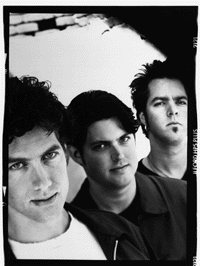 Better than Ezra |
Louisiana, SXSW was the thing you strove for. We had gotten turned down a lot
by the conference when we first started. Finally, we got in, and it happened.
SXSW started the serious courting. People may have heard about us, but we made
so many new contacts. Until then, in the eyes of the industry, we were just a
rumor. People hadn’t seen us. So here we could play in front of presidents and
people who could makes decisions.”
The Results: “It was kind of like we had been teetering on the top of a
hill waiting for someone to push us off and get momentum going. Our slot was
for a Thursday night at Steamboat, opening for Rex Daisy, another unsigned band
that had a much bigger buzz than ours. Everyone showed up. It really got the
ball rolling. You can become a bit of a commodity for those few days. It was
that night that we hung out with the people from Elektra, who we wound up
signing up.”
David Garza
David Garza is another one of those gray-area success stories, wherefinding a producer at SXSW meant finding a deal. As a member of Twang Twang
Shock-A-Boom, Garza played his first SXSW in 1990. Six years of solo SXSW
showcases followed with only nominal interest. But in 1995, after Garza nearly
abandoned hope of using the conference as his launching pad, the wife of
producer Stiff Johnson (G. Love, Cypress Hill) kneeled down to tie her shoes in
front of Steamboat and liked what she heard from outside. After the gig,
Johnson and Garza traded numbers, which ultimately led to the pair meeting in
Philadelphia to record a demo. In turn, that session’s tapes gave way to a
legitimate major label bidding war that ended with Garza choosing
Lava/Atlantic, which will release his national debut in August.
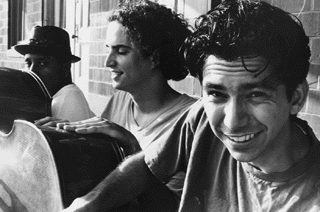 David Garza |
Studio 6A, with people from CBS and A&M expressing interest. But it was
kind of fun and games for me. I just thought it was cool to be playing the
Austin City Limits stage. By the next year, I’d broken up with my band
and realized major label deals were difficult to come by; and with Twang it
came so easy, because we got so popular so quick, I thought everybody must get
these [deals]. But you have to actually call these major label people in
advance and half of them don’t know who you are and the other half don’t care.
But by 1992 or 1993 I really began to take it too seriously. I’d spend January
and February biting my nails, worrying about what was going to happen at SXSW.
Everyone around me is asking the $20,000 question: “When are you going to get
signed?” The only reply, if you’re an Austin band is “SXSW.” Hopefully, at SXSW
they’ll see you, like you, and sign you. But it never actually happened. I’ve
played a good five SXSWs with random interest, but nobody knocking on my door
on March 16 saying “You’re the one,” contract in hand.”
The Lesson: “There were always the handshakes, always the business
cards, always the I-love-yous. Then there were the guys that said, `Play 50
gigs and call me.’ Ever hear that one? Yeah right, like I’m going to sit there
with a freakin’ pencil marking off gigs just to call. Then you play 50 gigs and
it’s “And you are…?” But the thing I learned is that every one of these major
label people are humans that like to laugh and have fun. They come to SXSW
because the weather’s good, they can play golf, and eat Mexican food. And
there’s lots of bands. But they want to have fun, not get hounded. You just
have to let them breathe and do the talking. If they don’t talk, they’re not
interested. And if you keep talking and talking you’re going to fool yourself
into thinking they’re interested because they sat there and listened. They’re
really not listening, they’re just trying to figure out who they’re going to go
talk to next anyway.”
[SXSW showcase: Thursday, Steamboat, Midnight]
Placebo
For many of SXSW’s international acts, the conference is about finding thesame things their American counterparts are seeking: a record deal, publisher,
lawyer, or booking agent. But few international bands arrived at SXSW with the
kind of frenzy Placebo brought with them to last year’s conference. Less than a
year after playing their first gig, a string of overwhelmingly positive British
press clippings brought over 35 different labels to see and meet with the band
in London. After they narrowed down the pack, they chose Hut Recordings, an
autonomous Virgin Records imprint that’s home to the Smashing Pumpkins and
Veruca Salt in the U.K.. But the deal still left open the band’s American
rights to any label within the Virgin family, which set off another bidding war
that ended with their decision to release their stateside debut on Caroline.
And to the band’s surprise, says frontman Brian Molko, Placebo not only
found a label over their weekend in Austin, they also found an American music
publisher.
Expectations: “Right before the conference, we had just gone through the
laboriously horrible two-faced, fake-plastic-smile process of meeting every
single record company guy you could image — eating with all of them and seeing
how they’d try to impress us. Some were genuine while others said, `Come up to
my hotel suite. I’ve got loads of cocaine and skunk weed we can get wasted on.’
Usually the ones with the drugs were the ones we didn’t like, so we made a game
out of basically taking them for a ride instead. In our minds we knew we
wouldn’t sign, but would just do their drugs. No worry, they’re free. We
figured we were game for another round in Austin.”
Results: “I was very impressed by Famous Music, who became our publisher
in America. At Steamboat, we played for 20 minutes and a guy named Bobby
Carlton, who works for Famous Music, came in, and saw us play for those 20
minutes. He’d never heard of us before. By the time we got back to England,
he’s put in an offer. We were quite amazed, because he hadn’t heard any demos
and decided on the strength of seeing us for 20 minutes that he wanted us. We
spoke about it a lot and knew that we really wanted to break America, and have
our music come through here. So we thought it would be very good for us to have
an American ally, and went for the Famous Music deal. After all we’d been
through, it was a surprising and perfect SXSW outcome.”
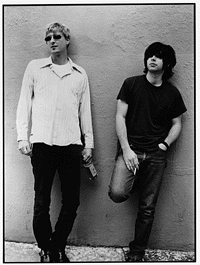
Whiskeytown
“Before SXSW, I really hadn’t had much interaction with label people, but soonenough we got very fucking familiar with the record industry,” says Ryan
Adams, Whiskeytown’s frontman. After the band rose to the head of last
year’s hot No Depression class with an album on Mood Food Records, it seemed
like everyone but Adams knew Whiskeytown’s 1996 showcase at the Split Rail
would turn into a major industry event. Adams himself says he was more excited
about the opportunity to hang out with the Old 97’s and get drunk with a
handful of Austin friends than he was about playing the show itself.
 Whiskeytown |
Ryan. “I didn’t show up to headline the Eno River Music Festival, the biggest
music festival in North Carolina because I was hungover. SXSW was the one thing
we did make, the one thing we showed up for that people could talk to us. And
it wound up being the turning point.”
After the show, Adams says he was mobbed by pushy A&R reps wielding their
business cards, forcing his quick and nervous retreat. Meetings, both in Los
Angeles and back home in Raleigh, North Carolina followed, and Whiskeytown
eventually settled on the Geffen-affiliated Outpost Records, which will release
their debut in August. But the band paid a price for their new accessibility
and interest: three members, including both halves of the rhythm sections, left
because of the chaos.
“In the end, playing SXSW was a great experience and something all of us are
going to remember,” says Adams, who’s returning to play this year’s conference,
partially to visit several of the now-close industry friends he’d made in the
process of not signing with their labels. “But after it’s all said and done,
the labels wanting to sign us was probably more detrimental than it was
positive.”
The Showcase: “If you’re a good band, your phone rings totally off the
hook as soon as you get home. We were a totally fucking lousy band at SXSW. I
couldn’t keep my guitar on, I was drunk, the microphone kept falling over, and
I think I fell over myself once or twice. I remember I loved playing the show
the way we did, but I was surprised at how well it went over because we had no
intention of going up there and being anything for anybody. Much later, after
we signed, a lot of people admitted they thought it was too rough or ragged,
but that’s who we were. But we just played like we do and I was amazed at the
interest.”
The Response: “As soon as we finished, everyone in the world wanted to
talk to us, especially to me. We all kind of split up and I wanted to hide. It
was madness and I couldn’t take to anybody. I was really needing a dr ink. I
talked to a few people and they scared me, so I sort of squirmed away. And as I
was kind of standing there, all these other people started coming and somebody
from SXSW grabbed me by the arm and escorted me to the van. It was partially
because we were interfering with the next band coming on, and also because they
knew I didn’t know what the fuck was going on. Then there were people knocking
on the van windows, and I just kind of looked at them. It was kind of rude, but
in retrospect I wished I’d done it more.”
The Aftermath: “As soon as we got home, our lives were different. There
were people flying in to meet us that had seen us at SXSW, but never met us
before. It really became a political issue, and the band started losing touch
with each other. In the process of choosing Outpost, we went through headfucks
from five different labels, and I felt like they were playing each of us in the
band against each other. There wasn’t a practice space, and we were expected to
fly around and have all these meetings, keep our jobs, and continue to tour. No
matter where we went, there was an A&R person there. It got to a point
where people in the band were skeptical of what this band was really about
anymore; it was getting stupid, almost like a talent contest…. That whole
part of my life was fucked up. I actually hated most of it. I think I liked the
attention, but I realized later what that kind of attention will do to a band.
You can really start to lose yourself and SXSW was the turning point.”
The Lesson: “This year, we’re playing on a bill with Hazeldine, a really
great band from Albuquerque that I expect will go through a lot of the same
shit we did. I’ve already gotten them a lawyer and have basically gone ahead
and found them some armor, some smarts. I’ve told them that when they’re done,
do yourself a favor, let me take your guitars off stage and you just fucking
leave. Don’t talk to anybody. I want them prepared, because I wasn’t.”
[SXSW showcase: Friday, Waterloo Brewing Co., Midnight]
This article appears in March 14 • 1997 and March 14 • 1997 (Cover).