


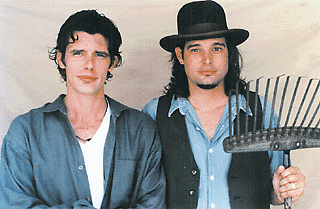
 photograph by Todd V. Wolfson |
Austin duplex probably should have been enemies. One was the live-in girlfriend
of the Cajun drug dealer/ne’er-do-well who had supplied the coke, the other was
his non-live-in, sometime-girlfriend. The women had only recently developed an
uneasy alliance: If he wasn’t with either of them, where was he? But it was the
mid-Seventies, and cocaine had a way of numbing the senses to such things as
common sense and standards.
The three of them talked mindless cocaine babble on that cold winter night
and continued to chip at the glittering white rock on the mirror before them,
the radio playing in the background to mute the conversation and laughter, and
numerous joints smoked to take off the edge. The young women warmed to each
other, noses frozen and eyes glassy, as the night seemed to go on forever. In a
burst of generous spirit, the live-in girlfriend turned to the other woman with
a smile. “Would you like to see my sons?”
The other woman smiled back. “Yes.”
The live-in girlfriend led the other woman down the hall and silently
opened the door to a small bedroom. Asleep in bunk beds were two
elementary-school-age boys. The live-in girlfriend beamed with pride, as only a
parent does. “This one is Charlie. And that one is Will.”
When Charlie Sexton hears this, he shakes his head, twisting his lips wryly, and mutters,
“figures.” For a moment, I’m sorry I told him about the first I ever saw him.
When Will Sexton hears the story, however, he throws his head back and laughs.
“You have to use that!”
Will and Charlie Sexton: brothers and musicians in a town where that status
immediately suggests another set of musical brothers, Jimmie and Stevie
Vaughan. Like those two, the Sextons balance separate-but-equal careers, and
have come full circle to record together. But that’s where the similarities
end.
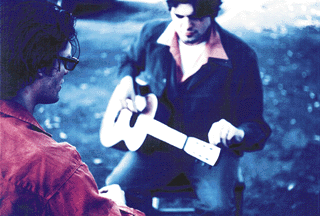 photograph by Todd V. Wolfson |
than half their lives. Both have chosen this life, but each has gone down a
different road toward that end, their careers seldom crossing even in the close
quarters of Austin. Their stories are checkered with professional triumphs and
personal struggles, prestige gigs and often-snide press, near-fame and sheer
talent, filtered through a gamut of musical styles; each career is a testament
to indomitable spirit and heartfelt ambition.
Charlie, who’s been written off as both a blues guitarist and a post-wave
rocker, performed onstage with his idol Tom Waits earlier this year,
punctuating the fact that he shares more in music spirituality with Alejandro
Escovedo than Stevie Ray Vaughan. Will, whose writing credits range from work
with Waylon Jennings and Stephen Stills to Joe Ely and Bill Carter, names Terry
Allen and Sheryl Crow hitmaker David Baerwald among his favorite writing
partners.
Both Sextons have stable, long-term marriages, and Will plays devoted father
to four-year-old McCauley. The Charlie Sexton Sextet still enjoys acclaim for
last year’s Under the Wishing Tree, even if it didn’t sell as well as
hoped, while Will’s musical collaborations keep him on the run between Austin
and Los Angeles. And then there’s the upcoming recording project on which the
siblings have embarked. The road to success was never easy, but right now, life
is looking pretty damn good for the Brothers Sexton.
Inside a high-
ceilinged rectangle in the Austin Rehearsal Complex that is clearly his haven,
Charlie is hunkered down amidst an exotic orchestra of instruments. Guitars,
steel guitars, dobros, and other string instruments line one wall, while a
piano, various drums, accordions, maracas, and other sundry rhythm utensils
line another. By the front door is a stand-up bass, and another tableau of
guitars, a cello and a dulcimer. “I love guitars… drums… these instruments.
They’re so curvy. It’s like looking at a beautiful woman. I just love them —
the instruments.” He flashes the movie star smile that made him the idol of
young Japanese girls in the mid-Eighties, and monkeys around duping some
cassettes.
In the background, down the hall, a punchy brass section is riffing on
“Messin’ With the Kid.” That would be Ian Moore, another stalwart of the
venerable complex. Charlie himself is one of the senior residents. “I just quit
smoking recently,” he says, tossing a cassette in his hand, that luminous
Sexton smile on display again. “So I have to do something with my hands.”
Charlie has just listened to a tape of the Waits show, which fell on his
birthday. He’s thrilled with it. “Someone gave [the tape] to my brother and he
gave it to me,” he explains. “Waits had me go out and do the encore with him.”
Charlie goes into an impromptu Waits impression, hunching over and lifting an
imaginary mike to his mouth, his left arm swinging spasmodically while he
stomps his foot and growls unintelligibly. This cracks me up. Charlie’s
willingness to clown for me is as endearing as his imitation of someone we both
admire tremendously.
He straightens up and reaches for a mandolin, plucking its delicate strings as
he talks about a professional career that began when he announced he was moving
to Austin at age 12. It didn’t phase his mother much, perhaps because, as
Charlie explained in an unusually frank record company biography for his last
album, he and his mother grew up together.
Kay was 16 when she gave birth to Charles Wayne Sexton on August 11, 1968 in
San Antonio, and was not yet married to Mike Sexton. She was barely 18 when
Will Allan Sexton was born, one day shy of two years later, August 10, 1970.
The boys’ father was striking to look at, with high, wide cheekbones,
mischievous hazel eyes, long sandy brown hair, a flashy rogue’s smile, and a
penchant for trouble. Kay was petite, a pretty brunette with soft hair waving
past her shoulders and beautiful liquid-brown doe-eyes, who had grown up in a
fundamentalist Christian family in San Antonio. Young Charlie seemed to take
his light coloring from Mike while Will took his from Kay — though both
inherited the high, sculpted cheekbones of their father.
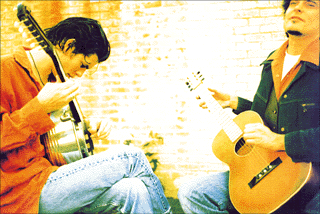 photograph by Todd V. Wolfson |
according to conventional notions, neither was their easygoing lifestyle
terribly unusual, even when they moved from San Antonio to Austin when the boys
were four and two. Kay and Mike probably didn’t consider themselves hippies,
but the hippie lifestyle that pervaded Austin in the Seventies was seductive
and accommodating, especially if limited education and income were factors. The
hot, sweaty days of the endless Texas summers were so much easier to bear in
the shade of the Armadillo Beer Garden, where long-haired little hippie
children ran around in gleeful abandon. At Soap Creek, where everyone was
always dancing, it wasn’t hard to line up a couple of metal folding chairs on
which to stretch the kids when they fell asleep.
For a whole generation of kids, this was a normal childhood — just ask Ian
Moore, Jake Andrews, Lisa Pankratz, or Tyrone Vaughan. Back then, having a
little guitar clutched in a tiny hand was the natural step to follow the teddy
bear. For Will and Charlie Sexton, going to clubs and falling asleep to live
music was simply another part of their youth.
But life in Austin had its unpleasant side too. In the early Seventies, Mike
Sexton was busted on a pot charge and sent to prison. In his absence, a
small-time Cajun dope dealer from Louisiana, whom Sexton had known
peripherally, made himself at home with Kay and the boys, who were just
starting elementary school. Trapped by circumstances that led her to depend on
his support while Mike was in prison, Kay survived the man’s abuse, eventually
breaking away. When Mike got out of prison, he felt alienated from his family
and stayed away until reconciling with them in the Eighties. The Cajun,
meanwhile, would later turn up dead in a Louisiana bayou.
Things eventually got a little better for the single mother and her two boys
when Kay met another man, one who was not abusive. This one, in fact, was a
musician, an Austin bass player named Speedy Sparks. Kay’s boys idolized him
and he in turn treated them lovingly, helping shape the young Sexton boys as
much as anyone, long after he and Kay split up and she re-married. It was
Sparks in particular that turned young Charlie towards music, giving rise to
one of the most public and well-documented careers in Austin’s musical history
— one that’s as chaotic as it is meteoric and uneven.
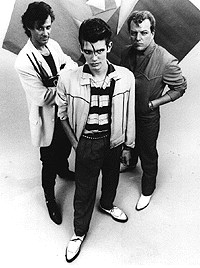 Charlie Sexton and the Eager Beaver Boys. Gary “Mudkatt” Smith and Alex Napier |
clubs, following that up a few years later with a stint in Joe Ely’s band,
which was touring as the opener for the Clash. By 16, he’d signed to a major
label. The kind of adolescent role-playing most growing teenage boys do,
Charlie did in public: Boy wonder Charlie playing behind W.C. Clark at age 10;
Good student Charlie learning at the feet of Jimmie and Stevie Vaughan, and the
legends who played Antone’s; Little Charlie in the Joe Ely Band (“I got paid
less than everyone else”); Rockabilly Charlie in the Eager Beaver Boys (“I wore
my hair like Elvis in the Army”); post-Wave Charlie for MCA’s Pictures for
Pleasure (“I did that to my hair myself! Every morning!”); Session Charlie
with Bob Dylan, Ron Wood, and Keith Richards; Hollywood Charlie on screen in
Thelma and Louise; return-to-blues-rock Charlie in the Arc Angels, where
it seemed like he was finally beginning to make his own music.
When the Angels folded their wings in 1993, Charlie already knew where he was
going. His subsequent band and album, the Charlie Sexton Sextet and Under
the Wishing Tree, revealed a more introspective Charlie, with songwriting
much matured. Many of the compositions on Wishing Tree were
biographical; there was “Spanish Words,” about his father doing time, and
“Plain Bad Luck and Innocent Ways” about Kay. Writing about family, working
with family, the seeds of a project involving both Will and Charlie were
already being sown. Things were already coming full circle.
But Charlie hadn’t just grown up; he’d done it in front of an audience
under less-than-ideal circumstances. Whereas most kids have a peer group their
age, Charlie’s peer group included Clark, Ely, the Vaughans, Lou Ann Barton,
Kim Wilson, then-Continental Club manager Wayne Nagel, and luthier Ted Newman
Jones. Austin’s club scene was his — and later Will’s — playground. He made
the most of his circumstances, saying in retrospect, “We were maybe the last
generation to benefit from the blues masters [at Antone’s]. We were really
fucking lucky to have had the influences we did firsthand — Albert Collins and
so forth. We were really lucky we didn’t learn blues off Led Zeppelin’s first
record.”
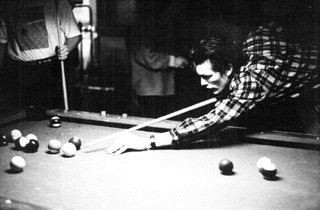 Charlie Sexton’s version of modern english |
well-learned. More than 15 years after beginning his long trek, he seems
remarkably at peace, content to spend downtime with his wife Karen and quite
satisfied with the direction of his music.
Will Sexton is a little late arriving at the ARC. He bursts into the rehearsal space, his thick brown
hair windblown and dark eyes merry. “Bliss is working in Westlake Hills and I
forgot about that Christmas tree in the park. I drove right through the middle
of that Santa’s Village thing on the way over. How long do I have to live in
this town to remember that’s there!”
Charlie kids him good-naturedly. “You’re late because you had to go through
Santa’s Village?”
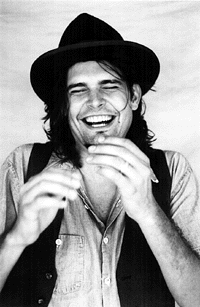 Will Sexton photograph by Todd V. Wolfson |
to give up my place!”
The younger of the Sextons has a reputation for being prickly — especially
with the press — though no more so than Charlie. They’re both nice guys, their
friends say immediately, then the hedging begins, Well, Charlie’s a sweetheart
and so is Will, but Will can be mercurial, they say. No, say others, Will’s
just a perfectionist, driven to achieve the best he can and not settling for
anything less. He hasn’t always been treated well in the press. Well, that lack
of appreciation for the Fifth Estate is understandable; Will sometimes got the
short end of the stick often poked at Charlie. Former Chronicle
columnist Michael Corcoran, for one, referred to Will’s career a “Magic
Coattail Ride.” Corcoran said much meaner things about Charlie.
“For years I’ve tried to hone being able to articulate stuff that means
something to me, on something I have to say,” says Will, explaining his
relationship with the press. “And for a long time, I felt that when people came
in for interviews, they’d come in with an idea already of what they wanted me
to say. So I’d say all this stuff about what I felt and in the end it was…”
He shrugs and makes a face, “well, uh….
“For example, in Little Rock once, at the end of an interview the guy asked
what I was doing and I said I had this Ford from my brother that I was driving.
Then we said goodbye. So I read the interview, and it has me driving around in
Charlie’s car, which had some sort of parallel significance to what he thought
I was doing as an artist or a human being or what have you. But mainly I’ve
never found much use in doing interviews when I’m not making records. It just
seems less than important to keep people filled in with what I’m doing
personally.”
And Will is outspoken. When I told him in a previous interview that I was a
little nervous about writing about two people I’d watched grow up, he replied
bluntly, “Nothing has ever really penetrated us… There’s this generalization
of who Charlie and I are and what our life is like, but I don’t think anyone
has a clue who we are. I think people can see us as being quite normal, but to
those who saw the degenerate quality in our lives, it’s real amazing we came
through it. It’s kind of bizarre, too, because Charlie and I have two different
recollections of our childhood.”
Charlie agrees. “I forgot that there’s so much Will doesn’t remember,” he
says. “Which is fortunate, because if he doesn’t remember the good times, he
doesn’t remember the bad times, either. For so long, I couldn’t understand how
he’d just…” Charlie whistles through a sailing motion. “Then I’d think, `Oh.
He doesn’t remember…'”
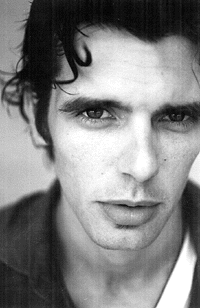 Charlie Sexton photograph by Todd V. Wolfson |
eight and he stuck around home and school for a while longer than Charlie, Will
too was in Austin by his mid-teens, playing as Will & the Cannonballs.
Later, like his older brother, Will found himself signed to MCA, making his
debut as Will & the Kill by the time he was 16 and moving up to New York in
pursuit of the rock & roll lifestyle and all that came with it.
The fire that burned so brightly for Charlie also burned for Will. When he
returned to Austin, he was already over the wild days and ready to pursue
songwriting. Soon after, at the tail end of the Eighties, Will met Bliss
McCauley and three years later their son was born. If things seemed unstable
during his childhood, he now sought that stability for his own family.
Somewhere along the line, he’d also developed a well-defined sense of
direction.
“I always felt better doing projects,” explains Will. “That’s what I
enjoy, being a part of something… I like doing something creative and I like
being part of something that’s not all me. It’s interesting to have this
log of your life of working with different musicians and different styles…
[When I say] I don’t care about being a musician, it’s because
`musician’ is such a strong word, a serious word. `Musician,’ to me, is someone
whose whole life is music. In the younger set, that’s like Doyle Bramhall II or
Charlie. You have to master an instrument to be a musician.”
Charlie expounds on Will’s thought. “Basically, what he’s saying is something
he told me months ago; `I don’t sit around and play guitar.’ Well, I
don’t either!” says Charlie, glaring at Will playfully.
Will kicks back and laughs. “Actually, the payback for that comment — and I
don’t even think I said it! — was `Yeah, Charlie sits around and plays
guitar… and violin… accordion… piano…'” The brothers laugh in
harmony.
It seems somehow appro-
priate during this holiday season that Will and Charlie are giving themselves
to each other now. Charlie is adamant that the decision for the brothers to
record together was an effort that had to happen at just the right time —
they’d had false starts already.
“Will and I were playing together one night before the last Sextet record, and
it just wasn’t the right time. I looked over on stage one night and he was
just…” Charlie imitates Will playing guitar and being off in his own world.
“After the gig, I said, `Listen, man, you gotta really really wanna do
this.'”
Will nods in assent. “[Bliss and] I had just had a son then — which was a
shocking experience — and Charlie and I talked and realized that I wouldn’t go
on tour then. It just wasn’t feasible with a new baby.”
It did become feasible this year, however, and with both careers on track.
Some material is written — even recorded — but the bulk of the album will
come later when management has found a label. The Sextet will be on board
playing behind the brothers, making the band name actually fit the numeric
designation that has become such an in-joke.
“Charlie, unfortunately, does most of the looking over his shoulder because
he’s doing all the production and generally has the musical themes,” says Will.
“I’m the one that’s thinking about shit that doesn’t have anything to do with
songwriting. I think of all these concepts. I’m the concept guy!
“Yeah, that occurs right when we’re working on a song,” Charlie adds
mischievously. “And he’ll go onto his big concept that’s so involved it takes a
while to explain. Finally, I’ll go, `Okay, I see. It’s like this…’ and then
[Will] goes into the history on the characters in the song. It’s not like he
writes the lyrics and I do the music. I just don’t have the brain capacity or
the space for some of those pieces he does and that’s the great marriage about
us — he’ll do all the research.”
 photograph by Todd V. Wolfson |
the bare bones of what you need.” Will points to Charlie. “He’s the king of
that!”
“Hey! You know what happens to kings!” Charlie protests playfully, then
mutters, “They get crucified.”
“Okay. He’s the one-legged prince of that.” Will concedes jokingly. “He’s got
that great talent of having lyrics that are simplistic and poignant.”
“I’m not a great lyricist in the way he is…” Charlie defers to Will, “but
that’s the great marriage…”
“…Yeah, just write something poignant and everybody understands!” Will
shoots back. “Charlie’s true talent is that he has such a deep psychosis that
he tries to write and it ends up being…”
“…`Helter Skel-ter?'” Charlie offers.
Will snorts with laughter and finishes. “You listen to the lyrics of a song,
and even if they’re a flat-out lie, that’s great as long as the listener gets
that.”
Charlie nods. “There’s a line at the end of a verse of a song we’re doing [for
this record]. And the last line of the verse is `…his heart was broken
before it could learn to communicate…’ And the ad-lib line that wasn’t
written was `and he ain’t good at talking.‘ I almost took it out when I
listened back to it, it made me so uncomfortable.”
“I thought he wrote it about me!” Will exclaims.
“I wrote it about every fucking guy in the world,” Charlie retorts.
“It’s interesting, the songwriting process,” Will reflects. “Charlie has Tonio
K, and Terry Allen is the same way for me… the greatest gift is being able to
surround yourself with people you respect.”
“It’s really difficult to find anyone to collaborate with,” Charlie agrees.
“Unless it’s a strict one-does-music, one-does-lyric. Collaborating with people
is not an easy thing to do to express that depth, that emotion, that reality —
whatever. So when you find people like that….” He smiles as his words trail
off.
Will steps in. “If someone ferrets you out as someone they want to work with,
they know what to expect. You might not have much in common with them, but
together you work it out and come up with something. So many times your `ideal’
songwriting partner is too similar, too compatible to work with.”
Charlie nods. “I’ve been writing with Tonio K for 10 years.”
Will teases. “Yeah, and I can’t stand him.”
“[Tonio K and I] are like The Odd Couple — Felix and Oscar,” says
Charlie, laughing. “We’ll be driving back from California and there’ll be these
episodes in the car that are like… well, he’s Felix, I’m Oscar!”
“Tonio makes sure you know he’s the Jack Lemmon Felix, not the Tony
Randall one,” adds Will with a smirk.
“When I’m working on a song,” Charlie continues, “and I get to the stage where
it’s really something, it’s like — wow! I’ll be in here listening and start
thinking about the lyric and it’s so exciting! And over a period it’s easy to
be jaded, especially when you’ve spent half your life doing it and haven’t been
completely successful much less applauded for the journey. It’s better that
we’ve waited until this stage for this project. We sort of grew together.”
And what did you discover about each other you didn’t know?
“Uhhhh…” Will makes a great show of feigning a lack of understanding.
“Want me to leave?” Charlie offers helpfully.
“No, I want you to make sure this is exactly what I said.” Will pauses and
speaks.
“I always kind of feared it would be the downfall of our relationship if we
worked together. That’s what I was afraid of. We’d much prefer to have a family
than a band. But what I realized was that that made us closer. Spending
more time together, we were able to figure each other out, to feel more
comfortable, reach a broader understanding of each other. That was the surprise
because it was my big fear to be put in a situation together real abruptly and
then come away with career animosity toward each other. So basically this is us
reworking our relationship, getting to know each other. ”
Charlie smiles warmly at Will’s words, at the expression of familial love and professional affection,
and Will grins back. In a season which demands reflection upon such things, two
brothers are finding their common ground, as deep and heartfelt a gift as can
be given or received. For just these few minutes here, the years of toiling at
recordings and gigs recedes into the background. Will and Charlie Sexton are
not musicians or songwriters, they are exactly what they were born to be and
nothing more: Brothers.
 |  |
| cover photographs by Todd V. Wolfson | |
This article appears in December 20 • 1996 and December 20 • 1996 (Cover).