

Brightly-colored
flowers and ribbons strewn throughout the little cemetery near the Art Carved ring plant caught my eye as
I drove by to deliver a catering order. My curiosity made me impatient to drop
the pastries and get back to the road for a closer look. On that crisp November
first afternoon, several Hispanic families were gathered in El Cementerio
Mexicano de Maria de la Luz to clean and decorate the graves of their
departed loved ones. Some were gathered around a picnic table under a tree to
share a meal, visiting with family and friends. I parked my truck across the
narrow road and watched for quite a while. People of all ages came and went,
greeting each other warmly and going about the business of renewing the ties
between the living and the dead. The idea of a picnic in the cemetery was
completely foreign and vaguely unsettling until I realized that it was
perfectly in keeping with the Mexican folk tradition of celebrating the dias
de los muertos, the days of the dead.
Food is an integral part of the annual Hispanic Catholic celebrations that
welcome the souls of loved ones home for a visit. Since ancient times in
Mexico, the living have lovingly prepared the favorite foods of the dearly
departed for this holiday. Repasts are taken to the cemetery to honor friends
and relatives no longer among the living, and then are shared by the mourners
after they’ve completed the ritual of cleaning and decorating graves. The
campos santos (cemeteries) in Mexico are festooned with ribbons, candles
and fresh flowers. Paths of brilliant yellow petals from the cempasuchil (yellow marigold) — the only colored flower that the eyes of the dead are able
to follow — are strewn to guide their souls to ofrendas (altars) in
their families’ homes. The ofrendas provide a threshold for the dead to
enter, attracting them with the enticing aromas of the foods and drinks they
enjoyed in life. Home altars are decorated with flowers, copal incense
burners, photos, and mementos of the departed plus their favorite foods and
beverages. The belief is that the returning spirits actually consume both the
aroma and the essence of the food and drink offerings while enjoying a
cigarette or wearing a favored article of clothing.
Folk wisdom dictates that returning spirits should be welcomed with genuine
offerings of food and drink out of a sense of respect and obligation. Mexican
folk literature is full of cautionary tales about careless people who declined
to prepare sufficient feasts and suffered bad luck or even death. One such
cuento (story) tells of a man who instructed his wife to prepare nothing
but a camote de malango (a bitter-tasting tuber) for his parents’ altar.
As the souls returned to the cemetery, the man hid in some bushes by the side
of the road and overheard his mother complaining that the bitter food had
burned her mouth and what a great insult she had suffered at the hands of her
selfish son. He was terribly shamed and experienced many incidents of bad luck.
These stories serve to reinforce the sense of obligation and responsibility
that keep the ancient traditions alive.
To honor the spirits of their ancestors, the Aztec Indians prepared feasts of
tamales and corn-based beverages such as atole and
champurrado, flavored with fruits, nuts, spices and chocolate. Those
elements of the traditional feasts are still served today, augmented by
foodstuffs incorporated from other cultures. The Spanish brought wheat flour,
dairy products and sugar to the new world, and later the French popularized
many yeast breads and pastries. Feasts vary in different regions of Mexico;
distinctive moles are served in both Oaxaca and Puebla; in Mixquic
outside the capital of Mexico City, tamales de ajolotes (a filling made
with tadpoles) and dishes made with the definitive local chilies
criollos sauce are customary; triangular ash tamales called
corundas are a delicacy in Michoacan; dulce de camote (candied
pumpkin) and carbonated fruit drinks can be found almost everywhere in Central
Mexico along with popular alcoholic beverages such as tequila,
pulque and mezcal.
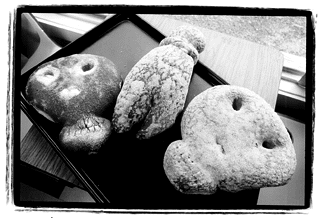 photograph by John Anderson |
Probably the most common foods found at dias de los muertos celebrations are pan de muerto (bread of the dead) and
champurrado, a hot chocolate drink seasoned with cinnamon and thickened
with masa harina (see recipes below). These festive foods are found in
Texas celebrations too. Bakers with a talent for bread sculpture have built
respected reputations and followings in cities with large Hispanic populations.
For years, the exquisitely-sculpted breads of Jesus Baez drew customers to El
Porvenir, an East Austin yerberia. Residents of the neighborhood
surrounding the store referred to it as “the good place to get the bread.” Baez
created loaves for the La Pe�a/Informe-Sida celebrations at the Our Lady
Family Center for several years before his retirement. This year, Austinites
ordered bread from La Mexicana Bakery on South First, Joe’s Bakery on East
Seventh and La Victoria Bakery on Burnet Road.
La Victoria owner Manuel Becerra makes two styles of breads, round
loaves topped with pieces of dough to represent bones and longer loaves in the
shape of human forms. Lightly dusted with sugar, they are delicious with coffee
or hot chocolate. Becerra reports that about half of his orders were placed by
schoolchildren and teachers who intended to place the breads on altars at their
schools.
Sanchez Elementary art teacher Lynn Bryant has been building and decorating
ofrendas for dias de los muertos with her students for several
years. Members of the Sanchez Hispanic Culture Club work with Bryant to design
and build an altar each year, decorating it with their flowers and art works,
clay and papier mach� foods. Last year, one altar honored Selena. This
year the altar honors the school’s namesake, Dr. George R. Sanchez, the father
of bilingual education. Bryant spoke with Dr. Sanchez’s widow about his
favorite foods and found that the New Mexico native was fond of pozole,
green Hatch chilies and stacked enchiladas made with blue corn tortillas topped
with a fried egg. The children made pozole for the school administration
and created clay enchiladas and papier mache peppers in all sizes to decorate
the Sanchez altar.
There is no way of knowing if the people picnicking in the Maria de la Luz
cemetery several Novembers ago had ofrendas at home set with foods
for their departed loved ones. But reflecting on the significance of their
participation in an ancient ritual inspired me to consider what foods I would
gather and prepare to honor my parents and grandparents who are buried far
away. Since a visit to their graves in Midland, Lubbock, and Post is out of the
question, an ofrenda would have to suffice. For my father, there should
be coffee, cigarettes and his favorite comb honey; for Mother, chocolate candy
bars with nuts like Baby Ruths and Snickers; my grandfather loved ham and a
smelly cheroot and there should be a glass of cold buttermilk with crumbled
cornbread for Nana. Nothing would please my travelling cowboy Uncle Charles
more than a West Texas hotel coffee shop breakfast, and for my namesake
grandmother Ginny who ran a Panhandle cafe and my great-grandmother whose
husband sold loaves of her homemade bread door to door during the Depression, a
homemade loaf of pan de muerto and cups of hot chocolate would honor
them nicely.
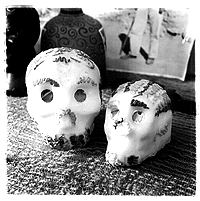 photograph by John Anderson |
Recipes for Dias de los Muertos
Foods used in the celebration of Dias de los Muertos vary from regionto region in Mexico and the U.S. Two of the most common elements are a slightly
sweet yeast bread called pan de muerto (bread of the dead) and a hot
chocolate beverage, champurrado, which is made with masa harina.
There are many different recipes for pan de muerto but the common
elements of all of them are eggs, anise seeds and orange flower water or zest.
The dough is formed into ovals or rounds with raised “bones” and “skulls” of
dough on top or into the shape of human forms. Many are glazed with plain or
colored sugar. The barely sweet bread is the perfect accompaniment for hot
chocolate, a pre-Columbian Mexican beverage made with water, chocolate, masa
and cinnamon. The hot chocolate is traditionally made in a glazed olla (pot) on top of the stove, stirred with a wooden molinillo and served
with a stick of Mexican canela (cinnamon) in each cup.
Pan de Muerto
5-6 cups flour
1/2 cup sugar
1 tsp salt
1 Tbs anise seeds
2 pkgs dry yeast
1/2 cup milk
1/2 cup water
1/2 cup butter or margarine
1 Tbs orange zest
4 eggs
Glaze:
1/2 cup sugar
1/3 cup orange juice
extra colored sugar for decoration
In the bowl of a mixer or food processor, combine 1 1/2 cups of the flour with
sugar, salt, anise and yeast. Combine the milk, water, butter and zest in a
saucepan and scald to melt the butter. Add the warm liquid to the flour mixture
and beat well. Add the eggs one at a time and then gradually add the remaining
flour until dough forms a slightly sticky mass. Knead dough using extra flour
if necessary with mixer or food processor (4-5 minutes) or by hand (8-10
minutes). Place dough in a greased bowl and cover. Let rise in a warm,
draftless place until dough has doubled in bulk, about 1 1/2 hours. Punch dough
down and form into desired shapes, cover and let rise for another hour. Bake in
a preheated 350 degree oven for 40 minutes. Bring sugar and orange juice to a
boil and then pour over warm loaf. Sprinkle bread with plain or colored sugar
for decoration. Adapted from Indo-Hispanic Folk Art Traditions II by Bobbie Salinas
(Pi�ata Publications, $16.95, paper).
Champurrado
(Mexican Corn Flour Hot Chocolate)
9 cups water
1/2 cup sugar or piloncillo
2 Tbs cinnamon
9oz tablet Mexican chocolate, chopped (Ibarra and Abuelita brands are common
here)
3/4 cup masa harina (corn flour for tortillas)
cinnamon sticks for garnish
Combine 2 cups water, sugar, cinnamon, chocolate and masa in a blender and
puree until smooth. Pour the mixture into a glazed clay pot or medium saucepan
with remaining water. Cook over low heat, stirring constantly with a wooden
molinillo or wire whisk until thickened, about 30 minutes. Serve
immediately with a cinnamon stick in each cup for garnish. n Adapted from The Mexican Gourmet by Maria Dolores Torres Yzabal and
Shelton Wiseman (ThunderBay Press, $39.95, hard)
This article appears in November 1 • 1996 and November 1 • 1996 (Cover).