

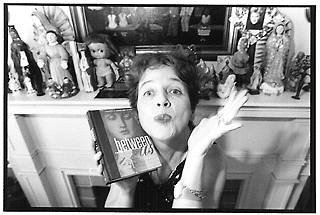
 Kay Turner: Author…Folklorist…Activist…Musician… photograph by Jana Birchum |
written between women who love other women, is the first such volume. Drawn
from thousands of letters gathered by Austin folklorist, writer, and Girls in
the Nose songstress Kay Turner, Between Us brings together the billet
doux of ordinary women with those of several famous ones. Other collections
have focused exclusively on the letters of a well-known lesbian or the
exchanges of a famous couple.
Comprising letters from the 1850s — when postal service became cheap and
widely available — to the present, the collection reveals the urgency,
passion, inventiveness, sorrow, and humor of lesbian love in its most personal,
written expression. In her expansive introduction, Turner touches on themes
invoked by the letters such as the necessity for lesbians to create models for
their relationships, the larger frame of women’s correspondence, the tenacity
of lesbian relationships, and the recurring motifs of cats and religion.
I first became aware of Kay Turner’s wacky and intelligent presence in the
late 1980s through performances of her band, Girls in the Nose. Singing songs
about breasts, pantyhose, and menstrual huts, the band hosted a Madonna Hoot
Night at Chances that featured a living buffet of fruit served from a reclining
woman’s navel. In 1993, Turner’s collection of women’s dreams about Madonna,
I Dream of Madonna, was published in an exquisite volume decorated with
witty collages of the Goddess of Pop. More recently, I encountered Turner in an
entirely different guise, as a spiritual guide bravely leading a tentful of
mourners in their celebration of the life of Austin artist and arts
administrator Rita Starpattern.
I interviewed Turner following a successful book tour that took her to the
East and West coasts, giving her the opportunity to meet many of the women
whose letters she published. She was even offered some “updates” on some
particularly thorny love affairs represented in the book. We got together at
the Flight Path and over coffee and hot chocolate had this chat.
A.C.: Kay, how do you describe what you do — your career?
K.T.: I describe myself as an “international lesbian activist folklorist”
(laughter). It doesn’t necessarily cover everything I do, but the two
main places that I come from. I’ve been doing lesbian and feminist activism for
25 years almost. That’s at the root of my personal mission, why I’m on the
planet. And folklore has provided me a way to get a certain kind of business
done in the arena of lesbianism and feminist activism; to sort of create a
basis for recording the expression of that in very common, grassroots terms. I
like to refer to it as “unmediated terms,” where the dreamlife of someone or
the letters that are written between two women are not structured forms of arts
— like fiction or poetry — their structure comes out of a certain kind of
unconscious desire. As a folklorist, I’m interested in seeing just what our
unconscious desires are and how they’re formulated into traditions and
practices that are carried out for the sake of both the individual and the
culture.
A.C.: In your introduction to Between Us, you offer a wide-ranging
definition of “lesbian” in your introduction: “simply to enjoy and suffer the
dramatic experience of loving another . . . woman, of casting one’s fate and
future with her for however long.” Has your inclusiveness ruffled anyone’s
feathers?
K.T.: Actually, I thought that that definition would come up for more scrutiny
than it has. It was my way of trying to introduce a view on lesbianism that was
broader and less tied to sexual practice, because a lot of the letters revealed
passion and love on a fairly grand scale. The imaginative kind of desire that
constitutes these relationships, the way in which the relationships gave rise
to a certain kind of freedom of the self and freedom of expression — even
dating back to the 15th or 16th century — was a commentary on what women found
in each other that they didn’t find within conventional heterosexual
structures. But also very much what they found with each other…. I
used that definition because there’s a letter from a very young girl in 1944 to
another. They came from Zionist Jewish families in New York and met at a
Zionist summer camp but they didn’t see each other much even though one lived
in the Lower East Side and one lived in the Bronx. They never had a sexual
relationship, but they loved each other. Both of them did eventually become
lesbian, but it’s the way in which they both drew on the culture of Judaism
(see box) that fascinated me. In this letter, you see the way a
14-year-old in 1944 takes the whole structure of Western civilization,
collapsing it for the purpose of what she found with this other girl.
A.C.: The letters occur one after another in the book, decorated with
beautiful collages. Brief stories about who wrote them and the circumstances of
their writing are in the back. Why did you chose to arrange them like
this?
K.T.: I wanted the letters to stand on their own as documents. I also wanted
the letters in the book to represent what I had found. There are about 67
pieces in the book and I read almost 6,000. When I was preparing the book I
created this map of lesbian culture and history as I discovered it in the
letters, so each letter here is emblematic of other letters of its type. That’s
kind of a folklorist’s way of doing things!
A.C.: In your acknowledgments, you mention the importance of lesbian and gay
archives as a resource for this book. Tell me about these collections.
K.T.: I drew on two distinct kinds of archives. Ones like the Ransom Center (at
UT) and the Beineke (at Yale) are heavily funded, well-managed, and parts of
major institutions. If they have one Radclyffe Hall letter, they’re going to
have 500 (such as the Ransom Center does). The lesbian and gay archives, on the
other hand, are still very much grassroots, volunteer-run. They need staffing
and funding desperately. So the personal materials there are difficult to get a
hold of. They’re in boxes that might have someone’s name on them.
There’s no one who’s gone through and cataloged them. Working in lesbian and
gay archives was strenuous physically, but what really blew my mind was that
there were excellent public materials from the post-liberation era –most
everything in the archives is post-1969. There is some stuff that precedes
that, especially in the Lesbian Herstory Archives (Brooklyn). The amount of
public versus private materials in these collections is shocking and I’ve made
this little plea on my book tour. I tell women to go home and to collect their
little shoe boxes full of love and don’t throw them away or let them get lost,
send them off to an archive!
A.C.: I think that when reading love letters between men and women the
assumption is that the lovers stay together. One thing that struck me here is
that these women don’t discount the intensity of the feelings expressed in
their letters just because the relationship didn’t “work out.”
 photograph by Jana Birchum |
without any kind of supportive social structure that condones the relationship,
then not only is the relationship riskier but the desire to manufacture a
structure that will carry it forward in some way becomes the burden of the
couple. What is certainly true of lesbian relationships — and something that
kind of links all of this material, the contemporary to very old — is the
incredible long-lastingness of the relationship which goes way beyond whether
they stayed together or achieved a marriage. I loved reading all of the
Virginia Woolf and Vita Sackville-West letters, from their very first letter to
the very last one that Woolf wrote about three weeks before she committed
suicide. Their relationship was still so important and alive for her, even
though the two of them had gone through so many twists and turns. The sense of
generosity in the letters and the way they revealed themselves and talked about
their relationship impressed me.
A.C.: How was the book tour?
K.T.: It was great. I started in Seattle and did the West coast and then New
York and Philadelphia. I was at feminist and straight bookstores. The publisher
had said, “Oh, it’ll be great if you get 20, 25, 30 people.” I was getting 60,
70, 80, 100 in the audience! What was funny was that not only did
letter-writers show up but all these people from my past! I read at A Different
Light in New York and these women were there I hadn’t seen in 25 years. These
old friends of mine from college had communicated back and forth between each
other for years, and they would say, “You know, some book came out about
Madonna. It was written by Kay Turner. Do you think that’s our Kay?”
They decided to come to the reading to find out if this was “their Kay.” So
there they were, lined up in the front row. I just started crying, I was really
moved.
A.C.: I love both of your books for their physicality: the beautiful
collages, the nifty size, the old dime book binding. They’re just gorgeous
books! Tell me how that came about.
K.T.: I was very lucky with the first book (I Dream of Madonna) because
I designed it and sent it to the publisher. A lot of times they want to buy the
content but want to send it to their art department. But they bought the whole
thing. I told them I wanted it to have this Nancy Drew quality. So we decided
to do it for this project, too.
The Madonna book started when I was doing my dissertation on Mexican-American
women’s home altars in the mid-1980s. I was working with old Mexican-American
women and they were telling me all these subversive stories about the Virgin. I
was being completely brought into the world of the Blessed Mother. It was very
important to me, not just as a scholar, but it was a personal journey, as well.
That was when I started dreaming about Madonna. So this Virgin-Madonna thing
came together for me in this very odd way. I started collecting the Madonna
dreams because it was so odd to me. I had this little file that was called
“Madonna & My Dreams” (laughter). I never intended to publish them!
But one day I decided to put the dreams together in a little package and sent
it to a couple of agents in New York. They loved it but they said: “We’re
afraid of Madonna, so we can’t take this.”
Then, Cynthia Rose, a wonderful writer — she’s from Texas but is based in
London now — was doing a book on the Virgin of Guadalupe so she came to Texas
to interview various people who’d worked on that material. We met and had a
long chat about the Virgin and then at the end of it she said: “Well, what else
are you doing?” So I said: “Well, I have this band and I’ve been collecting
these dreams about Madonna. . . .”
A.C.: What are you working on now?
K.T.: A book on women’s altars. It’s a book that looks at a cross-spectrum–not
only Mexican-American but everything from Wiccan to artists to traditional.
Also, when I was doing the lesbian love letters book I found some unpublished
Gertrude Stein material at the Beineke, love notes that Gertrude had written to
Alice at night. I published one of them in the book, but I’m going to do a
whole little selected book of them.
A.C.: Where do you hope the future will take you?
K.T.: Well, people will just fall over dead who know me, so you have to put
this in there: Kay hopes that she will live in New York at least for a
portion of her pathetic life. (laughter) I’m one of those people who
came to Austin with no intention of really staying here and now I’ve been here
half my life. I love Austin, but I have this eternal desire to live in the
city. I also hope to return to performances in some way. I’m actually thinking
of doing a performed version of the love letters because the readings went so
well. Orally, they are beautiful. You tend to read the letters individually,
but when you hear them, the voices that come out of them mount up. . . .
I have gobs of material that is still unpublished and I think it’d be fun for
it to take on a life of its own.
Kay Turner will give a reading from Between Us: A Legacy of Lesbian
Love Letters at Book People on Friday January 17 at 7pm.
Robin Bradford, a fiction writer, works at the Ransom Center and is a
regular contributor to The Austin Chronicle.
Interested readers should contact the Austin Lesbian Activism in the Seventies
Herstory Project at 326-5634 for information about archiving personal
documents.
This article appears in January 17 • 1997 and January 17 • 1997 (Cover).