

Pablo Picasso
Ruth Borinstein Gallery
on display until sold
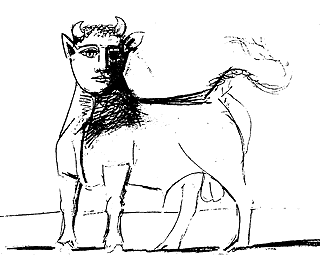 Bull With Human Head by Pablo Picasso, 1937 |
Pablo Picasso’s Guernica, an elaborate depiction of the distastrous
German bombing of Guernica, Spain in 1937. The mammoth work, 11′
51/2″ by 25′ 53/4″, came to the Museum of Modern Art in
New York in 1940, out of fear that it might fall into Nazi hands, and spent the
next 41 years there. It was shipped to Picasso’s native soil of Spain in 1981,
sparking cries of joy as well as animosity — cries similar to those that have
resonated throughout the painting’s tumultuous history.
Now, believe it or not, we have a little bit of Guernica in Austin.
Abbie and Ruth Borinstein, owners of Ruth Borinstein Gallery, recently
completed their annual art excursion to Europe, including a stay in Venice,
Italy. While there, they encountered a special show of graphics by Picasso,
including a complete portfolio of lithographs made from the original sketches
Picasso executed in the making of Guernica. The couple bought the
portfolio, which contains 42 lithographs — an incredible find for any Picasso
lover, even more incredible for a Picasso lover living in Austin, a town not
exactly known for its collection of European masters.
Master artists are the Borinsteins’ specialty. Lithographs by a dizzying array
of artists, including Chagall, Mir�, and Cassatt, line the walls of the
tiny space in Westlake Hills. The Borinsteins have been making the
Europe/Austin trek for more than 15 years, bringing back a bit of historical
European culture every time — though few pieces can claim to have stirred as
much political and cultural fervor as Guernica.
Sculptures
Charles Umlauf
Umlauf Sculpture Garden
ongoing exhibit
Unless you’ve been to the Umlauf Sculpture Garden in the past week, it has
been too long since your last visit. My arts assignment to you is to visit the
garden and museum and, upon arrival, kneel down on the leaf-strewn ground and
kiss it, giving thanks for this wonderful mini-paradise within the city.
Indeed, we are a lucky lot to have this massive collection of sculptures
nestled in our midst. Charles Umlauf was not only an exceptionally gifted
artist, he was, or so his sculpture suggests, a man of great sensitivity and
passion.
Umlauf and his wife, Angeline, donated their home, grounds, and more than 250
pieces of Umlauf’s work to the city of Austin in 1985, and since then it has
been transformed into a museum and garden, showcasing pieces spanning more than
a half-century of the renowned sculptor’s career. Yet Umlauf Sculpture Garden
is much more than a garden or a sculpture exhibit; it’s a walk through a land
of immortalized souls, frozen in time in wood, terra cotta, stone, marble,
bronze, and alabaster. It’s a little utopia, inhabited by lovers, bathers,
saints, and refugees, many so realistic and full of life, you’d think Medusa
was responsible for them.
One of the most emotional pieces is the achingly sad “War Mother,” a mother,
consumed with desperation, enveloping her frightened, wide-eyed child. Umlauf
made the smooth stone work in reaction to the war while living in Chicago in
1939. The piece generated vast national attention, which alerted UT’s art
department to the young artist’s work, providing the impetus for Umlauf’s move
to Austin in 1941. Fortunately for us, Austin remained his home until his death
in 1994.
On January 18, the museum will offer dollar day; consider it a day of beauty
for a buck.
— Cari Marshall
This article appears in January 17 • 1997 and January 17 • 1997 (Cover).