

by Cari Marshall
“Your work, metaphorically of course, falls between Marlene Dietrich’s
legs and the bitter lives of migratory potato pickers.”
In 1953, renowned photographer Robert Capa made this all-encompassing
statement to Eve Arnold about her burgeoning photography career; more than
four decades later, Capa’s words continue to best summarize Arnold’s work.
Her innate versatility with the lens is now one of her trademarks — it
has often been said there is no “Eve Arnold photograph”
— and one of the elements that has placed her among this century’s most
revered photographers.
Eve Arnold: In Retrospect, a stunning photography exhibit on display
through August at UT’s Leeds Gallery, allows Arnold’s boundless choice of
subject matter to shine through. Roy Flukinger, UT’s senior photography
curator, and April Rapier, a Houston art critic and photojournalist, curated
the touring exhibit, which has also appeared at the Menil Gallery in Houston
and the International Center for Photography in New York (the center’s highest-attended
opening ever).
The long-awaited retrospective collection — three years in planning
and organizing — is the culmination of one of photography’s greatest careers.
“Eve is certainly one of the key figures in at least American and British
photojournalism, possibly world photojournalism, for the second half of
this century,” Flukinger says.
“When I started this kind of reportage — essentially editorial
photography — it was basically an open field,” she said in a phone
interview. It was the heyday of picture magazines, the glory days of Life;
the perfect setting for a talented, ambitious and innovative photographer.
Arnold’s timing, with her career as well as her camera, is perhaps as essential
to her success as her versatility.
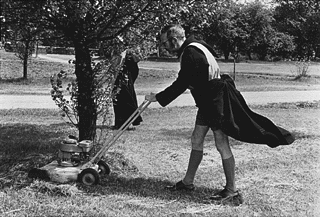 Father Gregory Wilkins, Nottinghamshire, England, 1963 |
Her innate sense of timing seems to capture the most interesting nano-second
in any given situation. “Eve tries to show environment and place,”
Flukinger says. “It makes her photos all the more human.” Most
shots contain not only the subjects but their immediate surroundings as
well, allowing for some remarkable detail. (Notice what’s laying on the
table in front of Elizabeth Taylor? And the expression of the man behind
Joe McCarthy?)
“She knows how to use dark as well as light, space as well as figures,”
Flukinger notes. “She inherently understands photo documentation and
explores people and their situations fully.” The exhibit seeks to convey
this point: Arnold’s genuine attempt to understand her subjects. She built
a reputation as a fair and trustworthy photographer who strives to portray
honest images, spending extensive time with her subjects — sometimes months
— to earn their trust. From the KKK to Malcolm X to the workers in Cuban
brothels, Arnold, camera in hand, gained access through seemingly impenetrable
literal and metaphorical barriers, all the while never abandoning truth
to herself, her subjects, and her craft.
In Retrospect is like a collection of short stories without words:
chronicles of women’s constricted lives in the Middle East; haunting tales
of a Soviet insane asylum and disease in Africa; intimate stories on the
beauty of Marilyn Monroe and the beautification of Joan Crawford; many stories
of people mundane and people exalted. In bringing them all together, the
exhibition also conveys the longer story of a sensitive and exceptional
photographer.
Arnold’s photographic career essentially began in Harlem. As a student
in a six-week photography course taught by Harper’s Bazaar Art Director
Alexei Brodovitch — her only formal training — she took as an assignment
Harlem fashion shows, a strong subculture generally ignored by the media.
It was during those fashion shows that Arnold realized a photojournalist’s
basic goals: to record social history, to write an appropriate caption,
and to follow a visual story line through the action’s beginning, peak,
and end.
During the Harlem shows — which she ended up exploring and documenting
for a year — she completely abandoned use of a tripod and began to get
a feel for available light. At the time, this fresh approach was still uncommon
among photojournalists, but for Arnold, less equipment and fewer burdens
meant more time and emotion to spend on the shot. In Retrospect includes
some of these early prints, taken when she was learning, as she calls it,
how to “search out and try to record the essence of a subject in the
125th part of a second.” This is when Arnold realized photography requires
no prescriptions, but plenty
of concentration and hard work.
In 1954, Arnold became the first American female to join Magnum, the prestigious international cooperative group of photographers. Then under
the direction (and non-direction) of veteran photographers including Robert
Capa and Henri Cartier-Bresson, Arnold learned to balance two polar opposite
views of photography: Capa’s “historic, haphazard” photo documentation
versus Cartier-Bresson’s “classically, brilliantly organized”
view of photography as art. It is a mastering of these two schools of thought
that emerges in each of her works; technical and artistic skill.
With Magnum, Arnold made a name for herself shooting, among others, Malcolm
X and Senator Joseph McCarthy, both in and out of their elements. She spent
months with each of these powerful figures, resulting in sometimes compromising
portraiture: McCarthy and cronie Roy Cohn rubbing elbows at the House Committee
on Un-American activities; Malcolm at a rally, fistfuls of dollars, a swindler
look on his face. Yet, in the exhibit, the Malcolm print is juxtaposed next
to a sincere, artful print of a Black Muslim high school graduation. The
photos’ placement is intentional, the curators’ attempt to convey Arnold’s
ability to portray a subject’s many facets. “The spatial relationships
are wonderful,” Flukinger said. “Arnold finds life’s juxtapositions.”
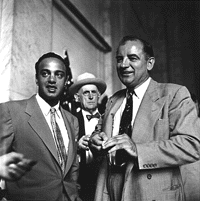 Roy Cohn and Joseph McCarthy, House Committee on Un-American Activities, Washington, D.C., 1954 |
Although she had built a strong, solid reputation in New York, she moved
to England in the early Sixties, and soon began working for the London Sunday
Times, which had just launched its color magazine. With creative freedom
and a plentiful budget, she would spend months on each story and shoot however
many rolls of film necessary to capture the vision in her head. During this
time, she explored using color more and more, and became a pioneer of the
color picture story.
The result is one of the exhibit’s most poignant sections, Behind
the Veil, an intimate look at the forbidden lives of women in Afghanistan,
Egypt, and the Arab Emirates. Colorful images of cloaks and veils, with
women’s faces and bodies barely discernible, quietly convey the female’s
strictly repressed role in Arab countries. The series is colorful and vivid,
yet dark and ominous; upon publication in 1970, it proved a striking social
commentary that made an indelible impression on Sunday Times‘ readers
in England and the U.S.
Arnold has published eight books of her works, including In America,
highlighting what she felt were the “inconsistencies and absurdities
current in (American) everyday life,” and In China, which she
called “the most exciting assignment of my professional life.”
The exhibit includes images from both of these collections, plus more images
from around the globe, including Italy, Spain, South Africa, and Ireland.
Her recently published autobiography, the mammoth Eve Arnold: In Retrospect,
is a beautifully cohesive and comprehensive showcase of the artist and her
work, with 100,000 words written by Arnold herself. “It all started
when I was supposed to write a 500-word introduction to a picture book,”
she says. “Now we have this.”
Arnold still resides — and works — in London, close to her son and
grandchildren. A seemingly ageless woman with unstoppable energy, she worked
closely with Flukinger and Rapier in the selection and exhibition of the
156 prints on display and attended all three U.S. openings. Collections
of Arnold’s work are as well-traveled as the artist; UT’s exhibit is concurrent
with another Arnold exhibit in England, soon to be followed by shows in
Australia, Hong Kong, and New Delhi, and a show of 100 prints about women
in Tokyo. “I guess it has been my year,” Arnold says. A most modest
understatement.
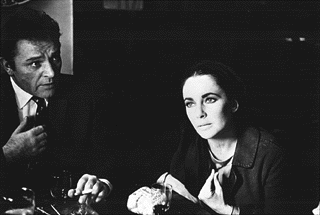 Richard Burton and Elizabeth Taylor during the filming of Becket, Shepperton, England, 1967 |
Much of Arnold’s time today is consumed with organizing her retrospective
exhibitions, though she is still active with her camera. She has seen a
significant portion of photography’s evolution, and has adapted along the
way. “In five years, I’m sure we’ll no longer be using film. It will
all be electronic images,” she says. “Sometimes I’m sad for people
starting out, how difficult it is these days.” She says television,
computers, and movies are tough competition, and require contemporary photographers
to explore beyond their lens.
“But I don’t think still photography will ever go away,”
she quickly adds. “And there’s nothing to replace a good eye.”
Eve Arnold: In Retrospect is on display through Aug 30 at the
Leeds Gallery, fourth floor of the Flawn Academic Center, on the UT campus.
Cari Marshall regularly reviews the visual arts for the Chronicle.
This article appears in August 16 • 1996 and August 16 • 1996 (Cover).