Letters at 3AM
If New Orleans were dry
By Michael Ventura, Fri., Sept. 16, 2005


During the last year, noteworthy articles have bounced around the Net implicating our government in 9/11. Some say the incompetence of our intelligence agencies was intentional, engineered by a right-wing cabal reaching all the way to the White House, seeking a "Pearl Harbor"-type event to justify its agenda. Some surmise more sinister scenarios. But does it really matter whether the coven of madmen responsible for 9/11 plotted in the West Wing or in an Afghan cave – or both? What matters far more is that we live in a time when covens of the maddened shape the agendas of countries all over the world, and that this is possible only because of a wildly out-of-balance way of life in which we all are implicated.
To blame disasters like the Twin Towers and New Orleans on a few perpetrators is to ignore the greater disasters that are the foundation upon which the developed world lives. Five percent of Earth's population (we citizens of the United States) use 25% of the world's oil and 40-50% of its resources. This fact causes immeasurable suffering for many of the remaining 95% of our fellow sharers. You've seen the stats many times: One third of the world lives on less than $2 a day, 20% are unemployed, 16% are chronically hungry; the list goes on and on. Our prosperity is based on those numbers. Obviously, if we had less, the world's impoverished would have more. They have so little because of an economic system we've instituted and enforced. Before Europe and the U.S. spread their tentacles to sap Earth's resources, most of its peoples lived passably well. Yes, I wouldn't want to be a woman in an African tribe or a man on an Asian rice paddy, even in their heydays; but I also wouldn't want to be a single mother in Philly or a migrant fruit-picker in California (they don't have heydays). The point is: The haves have a lot and the have-nots have not, and the haves have because the have-nots do not.
Most people reading this are haves. So am I. We are implicated. It is written in the Tao te Ching: "Prosperity rests on disaster; disaster is hidden in prosperity." This is true of our prosperity, whether Republicans or Democrats rule Congress and the White House. If our leaders are criminals that should come as no surprise, for we live on theft. We've invented polite words for our theft ("capitalism," "the global economy," "the free market"), but in fact it takes a lot of muscle and legalized theft for 5% of Earth's population to gobble 50% of its resources. Our way of life is a criminal enterprise, and it takes criminals to run it. For more than a century we've depended upon thinly veiled criminality for our good fortune, and we damn well are implicated.
Which is the underlying reason most Americans want to know nothing about their governance. To know would be to admit responsibility. To admit responsibility would put one in the moral dilemma of either taking action toward a more just world and thereby ultimately undermining one's own prosperity, or ignoring it all in the desperate attempt to live happily ever after. Many will believe anything that allows their fearful desperation to pose as righteous happiness. Any lie is welcome, and those who point out the lies are mightily resented. Democrats are as loath as Republicans to face the real problem. George W. Bush and the right-wing cabals cause tremendous and needless suffering, but they are not the fundamental problem. The problem is the way we sustain ourselves. The way we sustain ourselves causes much more suffering than Bush does. The way we sustain ourselves has brought disorder to every corner of the world and undermined the viability of the planet itself. Collectively, we are the maddened coven.
But we are also harried people trying to live our lives and cause no harm. That contradiction is the root of our madness: We are mostly good people sustaining ourselves in a manner that does great harm and evil, and we're stuck there – unable to face the contradiction. Even when we try to face it we are without the concepts or the means to right the situation. So we complain about politicians and argue about evolution. Doubtless, better leaders would do less harm, and it would be a boon if science could be taught freely in our schools. But rotten politicians are an effect of the problem, not its cause. Desperate fundamentalism is an effect, not a cause. The cause of the general chaos is the way we sustain ourselves. The fearsome imbalances in society and in nature result from our means of sustenance.
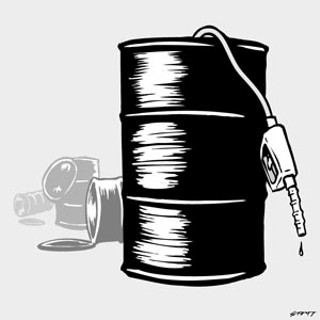
9/11 plunged us into the abyss of this dilemma. By attacking the Twin Towers and the Pentagon, the terrorists attacked whatever was left of our sanity – and of our means to deal with our root problem. Our root problem is that we've based our way of life on an unrenewable resource for which there is ever-increasing demand. Global commerce depends upon cheap transport. Cheap transport is soon to be a thing of the past. With the growth of China and India, and the strain that's put on oil production, our society would be facing great change even if 9/11 and Iraq had never happened (not to mention the effects of global warming). With or without 9/11 and Iraq, the way we sustain ourselves was about to change – to change sanely or insanely, depending upon our response to the root problem. Instead, as a society, we've ignored the root problem and concentrated on the aftermath of 9/11. Our response to 9/11 pretty well finished sanity as an option.
In a sense, the horrible spectacle of 9/11 entranced us. It is easy to blame Bush & Co. for playing on America's fears, but be fair: The fears were there to be played upon, and a free people chose to be played rather than to deal. Our state of denial has been encouraged by every president since Harry Truman. Truman had, on his desk, surprisingly prescient studies of how and when the oil would run out. He, and every president after him, chose to pretend it wasn't so, and invited the rest of us to pretend. We were only too happy to oblige. But the truth was out there. I read articles about it in Lubbock's Avalanche-Journal 32 years ago. We chose not to know, and Bush played upon that choice. We are implicated.
9/11 was tragic in many ways, for many people, but our response to 9/11 was far more tragic. Our response to 9/11 undermined America's freedom and prestige, and made an unholy mess of Afghanistan and Iraq. Our response to 9/11 permitted an unscrupulous Congress to drive our country into unspeakable debt while making the rich much richer and our middle class and poor much poorer. Our response to 9/11 even contributed to the catastrophe of Katrina. In fact, our response to 9/11 is a fundamental cause of that catastrophe. For years people predicted that New Orleans' levees couldn't withstand a hurricane's storm surge. Louisiana officials and the Army Corps of Engineers pleaded for money to strengthen the levees. As Maureen Dowd reported (The New York Times, Sept. 3, p.21), "In June 2004, Walter Maestri, emergency management chief for Jefferson Parish, fretted to The Times-Picayune in New Orleans, 'It appears that the money has been moved in the president's budget to handle homeland security and the war in Iraq.'" Another Times article (Sept. 2, p.23) reports that "the corps never tried to hide the fact that the spending pressures of the war in Iraq ... [were] the reason for the strain." We take out Falluja, then the very fact that we're in Iraq takes out New Orleans.
But in the biggest picture of all, even all that awfulness (important as it is!) is merely foreground. The background is more important. Behind everything listed in the above paragraph, and motivating everything listed in the above paragraph, is the desperate attempt to hold on to something we can't keep: an unsustainable way of life.
We are right to scream against the failures of government, federal and local, for which people needlessly suffered and died in New Orleans. Yet, once again, we are focusing on effects, not causes. If the levees hadn't been breached and the streets of New Orleans were dry, Hurricane Katrina would still have taken out the ports, oil rigs, refineries, and infrastructure that highlight the fragility of how we sustain ourselves. If 9/11 had never happened, if New Orleans were dry, we could still expect $4-a-gallon gasoline by Easter, if not Christmas, and $6 by next Labor Day. If 9/11 had never happened and if New Orleans were dry, our basic way of life would still be threatened with drastic, inevitable change – change for which we are utterly unprepared.
We've chosen not to face the facts, and that only makes the facts meaner. The facts are about to face us.